Introduction
Imagine a manufacturer machining high-strength steel parts, only to see tooling wear out after a few dozen pieces—slowing production and driving up costs. Or an aerospace supplier needing tight tolerances on a titanium component, but finding standard tools cannot maintain precision. These are the challenges carbide machining solves. Tungsten carbide, with its exceptional hardness and heat resistance, has revolutionized metalworking. It enables manufacturers to tackle tough materials and demanding applications with confidence. This guide explores how carbide machining works, why it is essential, and how to leverage it to overcome production challenges.
What Is Carbide Machining and Why Does It Matter?
Carbide machining relies on tools made from tungsten carbide—a composite of tungsten carbide particles bonded with cobalt. This material combination delivers properties ideal for demanding machining tasks.
Key Properties of Tungsten Carbide
| Property | Carbide Value | HSS Value (for comparison) |
|---|---|---|
| Hardness | 85 – 95 HRC | 60 – 65 HRC |
| Heat resistance | Up to 1,000°C | Up to 600°C |
| Tool life | 5–10 times longer | Baseline |
Performance Benefits
| Benefit | Impact |
|---|---|
| Hardness | Cuts through stainless steel, titanium without dulling quickly |
| Heat resistance | Maintains hardness at high temperatures; ideal for high-speed machining |
| Tool life | Reduces tool change downtime; a study found switching to carbide reduced downtime by 70% in steel machining |
Bottom-line impact: Manufacturers using carbide machining report 30% higher productivity and 25% lower per-part costs compared to HSS-based processes.
What Carbide Tools and Tooling Are Available?
The effectiveness of carbide machining depends on choosing the right tools for the task.
Tool Types and Applications
| Tool Type | Description | Best For |
|---|---|---|
| End mills | Shaping flat and curved surfaces | 4–6 flutes for stainless steel; 2-flute for aluminum |
| Drills and reamers | Creating precise holes | Parabolic flute designs for deep-hole drilling; efficient chip removal |
| Inserts | Replaceable cutting tips mounted to tool holders | Cost-effective for high-volume production; various shapes (square, round, triangular) |
| Tool holders | Secure inserts and tools | Rigid designs to minimize runout |
Tool Coatings
| Coating | Benefits |
|---|---|
| PVD (Physical Vapor Deposition) | Reduces friction; extends tool life |
| CVD (Chemical Vapor Deposition) | Provides wear resistance at high temperatures |
| TiAlN (titanium aluminum nitride) | Increases carbide tool life by 50% in high-temperature applications |
Carbide Grades
| Cobalt Content | Characteristics | Applications |
|---|---|---|
| 6–8% | Higher hardness | Finishing operations |
| 10–15% | Greater toughness | Roughing operations |
What Machining Processes Use Carbide Tools?
Carbide tools excel across a wide range of machining operations.
Turning
Carbide inserts shape cylindrical parts on CNC lathes. Achievable surface finish: Ra 0.8 μm in steel—far better than HSS tools.
Milling
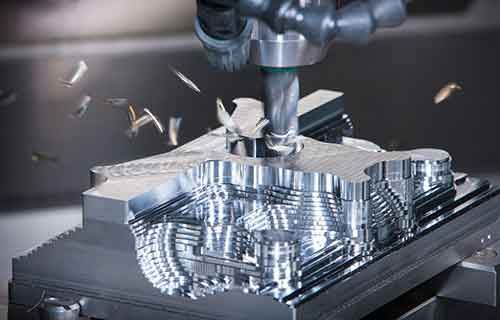
Carbide’s rigidity allows faster feed rates. 5-axis CNC milling with carbide tools produces complex aerospace components with tolerances as tight as ±0.001 mm.
High-Speed Machining (HSM)
Carbide tools handle spindle speeds above 10,000 RPM. In one automotive application, HSM with carbide reduced cycle time for a transmission part from 12 minutes to 5 minutes.
Grinding
Carbide grinding wheels achieve precise finishes in hard materials. Essential for sharpening cutting tools and finishing die components.
Process Optimization
Adjusting cutting parameters for carbide tools significantly improves results. For example, increasing cutting speed by 20% in aluminum machining reduced cycle time without compromising surface quality.
What Materials Are Suitable for Carbide Machining?
Carbide tools shine when machining hard and abrasive materials that quickly wear down other tools.
| Material | Machining Challenges | Carbide Advantage | Typical Applications |
|---|---|---|---|
| Steel | High toughness; generates heat | Heat resistance prevents dulling | Automotive parts, structural components |
| Stainless steel | Work hardening; abrasive | Wear resistance maintains sharp edges | Medical devices, kitchen equipment |
| Titanium | Low thermal conductivity | Efficient heat dissipation | Aerospace components, implants |
| Exotic alloys | High strength at high temps | Hardness resists deformation | Jet engine parts, oil rig components |
| Aluminum | Soft; prone to built-up edge | Smooth cutting reduces chip adhesion | Consumer electronics, aircraft parts |
Even soft materials benefit: Carbide tools produce better surface finish in aluminum than HSS, reducing post-machining polishing.
How Does Carbide Machining Ensure Quality and Precision?
Carbide machining’s ability to maintain precision makes it indispensable for quality-critical applications.
Tolerances and Accuracy
| Metric | Achievable Value |
|---|---|
| Typical tolerance | ±0.0005 mm |
| Medical device example | 99.9% of parts meet dimensional requirements (vs. 95% with HSS) |
Surface Finish
| Operation | Achievable Finish |
|---|---|
| Turning | Ra 0.8 μm |
| Finishing operations | Ra as low as 0.02 μm |
Eliminates secondary processes like honing in many cases.
Repeatability
| Metric | Value |
|---|---|
| Process capability (CpK) | 1.67 (industry standard is 1.33) |
Stable performance ensures consistent results across production runs.
Quality Assurance
- In-process inspection: CMM (Coordinate Measuring Machine) checks during production.
- Final inspection: Optical tools and metrology verify dimensions.
- Documentation: Inspection reports provided with shipments.
Where Is Carbide Machining Used?
Carbide machining serves critical applications across industries.
| Industry | Applications | Why Carbide? |
|---|---|---|
| Aerospace | Turbine blades, structural components from titanium and Inconel | Withstands high strength and abrasiveness |
| Automotive | Engine blocks, transmission parts; high-volume production | Fast, accurate machining; one car manufacturer reduced tooling costs by $200,000 annually |
| Medical | Surgical instruments, implants from stainless steel and titanium | Precision and accuracy for critical components |
| Energy | Oil and gas components: valve bodies, drill bits | Corrosion and wear resistance in harsh environments |
What Equipment and Technology Enable Carbide Machining?
Carbide machining requires equipment that can leverage the tools’ capabilities.
CNC Machines
| Requirement | Why It Matters |
|---|---|
| High spindle rigidity | Maximizes carbide tool performance |
| Precision | 15,000+ RPM spindles for high-speed machining |
| Rigid tool holders | Minimizes runout; improves accuracy |
Coolant Systems
| Feature | Benefit |
|---|---|
| High-pressure (1,000+ psi) | Reduces heat and chip buildup |
| Through-spindle cooling | Delivers coolant directly to cutting zone; particularly effective with carbide tools |
Metrology Tools
| Tool | Purpose |
|---|---|
| Laser scanners | Surface and profile verification |
| CMMs | Dimensional accuracy; detects deviations as small as 0.0001 mm |
Advanced Technologies
| Technology | Benefit |
|---|---|
| Adaptive machining | Sensors adjust cutting parameters in real time; optimizes performance; prevents tool breakage |
What Is Yigu Technology’s Perspective?
At Yigu Technology, we harness the power of carbide machining to deliver precision parts for demanding applications. Our arsenal includes:
- High-speed CNC machines with rigid spindles and through-spindle cooling.
- A wide range of carbide tools —end mills, drills, inserts, and custom tooling.
- Experienced engineers who optimize cutting parameters for each material.
Whether machining stainless steel for medical devices or titanium for aerospace, we leverage carbide’s advantages to ensure accuracy, productivity, and cost-effectiveness. Our commitment to quality means every carbide-machined part meets the strictest standards—from initial design to final inspection.
Conclusion
Carbide machining delivers precision and performance through tungsten carbide’s exceptional hardness (85–95 HRC) and heat resistance (up to 1,000°C). Carbide tools last 5–10 times longer than HSS, reducing downtime and costs. They excel in turning, milling, high-speed machining, and grinding—handling materials from steel and titanium to aluminum and composites. Achievable tolerances as tight as ±0.0005 mm and surface finishes down to Ra 0.02 μm meet the demands of aerospace, automotive, medical, and energy industries. With proper equipment—rigid CNC machines, high-pressure coolant, and advanced metrology—carbide machining transforms tough materials into precision components reliably and efficiently.
FAQs
When should I choose carbide tools over HSS?
Choose carbide for hard materials (steel, titanium, stainless steel), high-speed machining (above 10,000 RPM), or high-volume production. HSS may be more cost-effective for soft materials (aluminum, brass) or low-volume, low-speed applications where tool life is less critical.
How do I extend the life of carbide tools?
Use proper cooling (high-pressure, through-spindle coolant), select the right carbide grade and coating for the material, and avoid excessive feed rates or depths of cut. Regular tool inspection and reconditioning (resharpening) also extend life.
Can carbide tools be used for non-metal materials?
Yes. Carbide tools are effective for machining plastics, composites (carbon fiber, fiberglass), and even wood in industrial applications. Their wear resistance and precision produce clean cuts and reduce delamination in composites.
Contact Yigu Technology for Custom Manufacturing
At Yigu Technology, we specialize in carbide machining for complex, high-precision components. Our 3-axis, 4-axis, and 5-axis CNC machines are equipped with high-pressure coolant systems and rigid tool holders to maximize carbide tool performance. We work with a wide range of materials—from aluminum and steel to titanium and exotic alloys—serving aerospace, automotive, medical, and energy industries. Our quality systems include ISO 9001, and we provide DFM feedback to optimize your designs for manufacturability.
Ready to harness the power of carbide machining for your next project? Contact Yigu Technology today for a free consultation and quote. Let us help you achieve precision and performance that drive results.