The concept of a turning shop has evolved dramatically from a floor of standalone lathes to a highly integrated, data-driven manufacturing cell. Today, a successful turning shop is a symphony of advanced machinery, strategic tooling, smart programming, and rigorous quality control, all orchestrated to maximize precision and profitability. Whether you’re an experienced machinist looking to modernize or an entrepreneur entering the field, understanding the core components of a contemporary operation is critical. This guide will walk you through the essential pillars—from equipment and tooling selection to material choices and process optimization—that define a competitive and efficient turning shop ready for today's manufacturing challenges.
What Defines a Modern Turning Shop?
A modern turning shop is no longer defined solely by the presence of lathes. It's characterized by integration, automation, and data intelligence. The key shift is from manual, isolated operations to a connected, streamlined workflow.
The core philosophy is lights-out manufacturing capability. This doesn't necessarily mean full unmanned production overnight, but it requires systems that minimize human intervention for repetitive tasks. An illustrative example is a shop that runs high-volume medical component batches. They utilize bar feeders and automated part catchers on their CNC lathes. An operator loads a 12-foot bar of stainless steel in the morning, and the machine runs an entire shift producing thousands of parts, with only occasional attention for tool wear offsets. The modern turning shop floor is clean, organized, and features machine monitoring systems that display real-time OEE (Overall Equipment Effectiveness) dashboards, alerting managers to downtime before it becomes critical.
Which Lathe Types Dominate Today’s Turning Shop?
The choice of lathe is foundational. The dominance of specific types depends on the shop's niche, but two categories lead the market: Multi-Axis CNC Turning Centers and Swiss-Type Lathes.
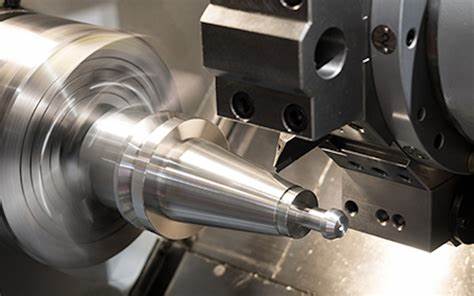
- Multi-Axis CNC Turning Centers: These are the workhorses for complex, prismatic parts. A modern turning shop will heavily invest in models with live tooling (motored tools that can mill, drill, and tap) and a Y-axis or a sub-spindle.
- Case in Point: Imagine producing a hydraulic fitting that requires turning, cross-drilling, and milling a flat with threaded holes. On a 2-axis lathe, this requires multiple setups on different machines. On a 6-axis turning center with a sub-spindle, the main spindle performs OD turning. The part is then transferred to the sub-spindle, where live tools engage to mill and drill, completing the part in a single chucking, slashing cycle time and improving concentricity.
- Swiss-Type Lathes: Dominant in the production of long, slender, and complex parts like medical implants and precision shafts. Their defining feature is a guide bushing that supports the bar stock right at the point of cut, eliminating deflection. For a turning shop specializing in high-precision, small-diameter components (e.g., 2mm diameter bone screws), a Swiss-type lathe is irreplaceable. These machines often feature multiple tool stations and can integrate secondary operations seamlessly.
| Lathe Type | Best For | Key Advantage | Typical Industry |
|---|---|---|---|
| 2-Axis CNC Lathe | Simple shafts, bushings, high-volume rounds | Cost-effective, fast cycle times for simple parts | Automotive, general manufacturing |
| Multi-Axis Turning Center | Complex parts requiring milling/drilling | Complete part machining in one setup | Aerospace, defense, fluid power |
| Swiss-Type Lathe | Long, slender, small-diameter parts | Superior precision on delicate components | Medical, dental, electronics |
| Multi-Tasking Mill-Turn | Extremely complex, asymmetric parts | Combines heavy milling and turning capabilities | Aerospace (blisks, impellers), energy |
How to Select Cutting Tools for a Turning Shop?
Tool selection is where engineering meets economics. The rule of thumb is to match the substrate, coating, and geometry to the material and operation, not to seek a universal "best" tool.
Experience-Driven Insight: In our shop, we faced excessive tool wear and poor surface finish when machining Inconel 718 for a turbine component. We were using a standard carbide insert with a universal chipbreaker. The solution was a three-pronged change:
- Substrate: We switched to a whisker-reinforced ceramic insert for the roughing passes to handle the extreme heat.
- Coating: For finishing, we used a PVD-coated carbide with a AlTiN layer for its hardness and heat resistance.
- Geometry: We employed a high-positive rake, sharp edge geometry for finishing to reduce cutting forces and prevent work hardening of the material.
The modern approach also involves standardizing toolholders (like VDIs or Capto systems) across machines to reduce setup time and presetting errors. Investing in a tool presetter offline can save 15-20 minutes per setup, which translates directly to more spindle time.
What Materials are Most Profitable in a Turning Shop?
Profitability isn't just about material cost; it's about value-added machining. Exotic alloys often command higher machining rates. A strategic turning shop will balance a portfolio of materials.
- Aerospace Alloys (Titanium, Inconel): These are high-value, challenging-to-machine materials. Profitability comes from expertise. Shops that master these materials can charge premium rates ($120-$250/hr). The key is controlling heat and using the correct toolpath strategies (e.g., trochoidal turning for roughing Inconel to maintain constant load).
- Stainless Steels (303, 304, 316, 17-4 PH): The bread and butter for many job shops. Consistent demand from medical, food, and marine industries. Profitability hinges on efficient cycles and tool life optimization.
- Engineering Plastics (PEEK, Delrin, UHMW): Often used for prototyping, insulators, and wear components. They machine quickly but require sharp tools and specific clamping pressures to avoid deformation. High margins can be achieved due to low raw material cost and fast cycle times.
- Aluminum: Perfect for high-speed machining. While per-part profit may be lower, volume makes up for it. Shops with high-speed spindles (10,000+ RPM) can achieve incredible cycle times, making aluminum highly profitable for large batches.
How to Program Efficient Cycles in a Turning Shop?
Efficient programming is the brain of the operation. It goes beyond basic G-code to leveraging advanced CAM software features and machine-specific cycles.
The most impactful strategy is using custom macro programming (parametric programming). For example, a family of similar flanges requires only diameter and bolt circle changes. Instead of writing a new program for each, a macro program uses variables (e.g., #100=Major_Dia). The operator simply inputs a few parameters, and the program adapts. This reduces programming time from hours to minutes and virtually eliminates programming errors for similar parts.
Furthermore, simulation software is non-negotiable. A near-miss story: A programmer created a complex cycle for a mill-turn part but missed a clearance issue with a boring bar holder. The simulation software flagged a collision, saving a $15,000 spindle repair and days of downtime. Modern CAM also optimizes toolpaths for constant chip load and smooth engagement, which can improve tool life by 30% or more.
What Quality Checks Secure Turning Shop Tolerances?
Quality assurance must be in-process, not post-process. Relying solely on a final inspection with a caliper is a recipe for scrap.
- First Article Inspection (FAI): A comprehensive FAI using a CNC CMM is mandatory for any new part. This validates the entire process.
- In-Process Verification: This is critical. Tool probe systems on the machine can automatically check and compensate for tool wear after a set number of parts. On-machine probing can check critical diameters and lengths mid-cycle. If a dimension is drifting out of tolerance, the machine can adjust offsets or stop itself, preventing a batch of bad parts.
- Statistical Process Control (SPC): For long runs, measuring key dimensions on a sample of parts and plotting them on an SPC chart provides a visual control. Trends can be spotted before they exceed control limits. For a turning shop producing 10,000 hydraulic spools, implementing SPC on the critical sealing diameters reduced scrap rates from 2% to under 0.1%.
Conclusion
Building and operating a leading-edge turning shop is a multifaceted endeavor. It requires a strategic investment in the right multi-axis machinery, a deep, experiential understanding of cutting tools and materials, intelligent programming practices that leverage automation, and a quality-first mindset embedded into the machining process itself. The modern turning shop thrives not by running faster alone, but by running smarter—integrating technology to enhance precision, predictability, and ultimately, profitability. By mastering these interconnected pillars, your shop can transition from a job executor to a valued manufacturing partner.
FAQ
What is the main difference between a CNC lathe and a turning center?
A basic CNC lathe typically performs turning operations only (X and Z axes). A turning center incorporates additional axes (like a C-axis for spindle positioning) and live tooling, allowing it to perform milling, drilling, and tapping, enabling complete machining in one setup.
How much should I invest in tooling for a new turning shop?
A good rule of thumb is to allocate 15-25% of your machine's cost for initial tooling, holders, and presetting equipment. Do not underinvest here; quality, consistent tooling is essential for holding tolerances and maximizing machine uptime.
What is the most common mistake when starting a turning shop?
Underestimating the importance of workholding. Investing in high-quality, versatile chucks, collets, and fixtures is crucial. Poor workholding leads to vibration, poor surface finish, and dimensional inaccuracy, nullifying the capabilities of even the best lathe.
Can a turning shop be profitable with just one machine?
Yes, but it requires a sharp niche. A single, well-utilized multi-axis turning center or Swiss-type lathe serving a specialized market (e.g., medical prototypes or aerospace brackets) can be very profitable. The key is to maximize spindle uptime through efficient scheduling and quick changeovers.
How important is CAM software for a modern turning shop?
It is essential. While simple parts can be hand-coded, advanced CAM software is required for programming complex multi-axis toolpaths, simulating for collisions, and optimizing cycles for speed and tool life. It is a productivity multiplier that pays for itself quickly.
Contact Yigu for Custom Manufacturing.
At Yigu, we view the modern turning shop as the precision core of advanced manufacturing. Our experience aligns perfectly with the principles outlined above. We have invested in a fleet of multi-axis turning centers and Swiss-type lathes not as standalone assets, but as interconnected nodes in our digital manufacturing ecosystem. For us, profitability is engineered through material intelligence—we don't just machine Titanium Ti-6Al-4V; we have developed proprietary toolpath and cooling strategies that extend tool life by over 40% for this alloy, savings we pass on as value to our clients in the aerospace sector.
Furthermore, our commitment to in-process quality is absolute. Every critical turning cell is equipped with on-machine probing and tool monitoring systems, ensuring that the tolerance specified on your drawing is the tolerance you receive, part after part. We believe a true partner doesn't just run your program; they engineer the entire process for reliability and efficiency.
If your project demands the synergy of advanced equipment, deep material expertise, and a data-driven quality system, contact Yigu. Let's discuss how our modern turning shop capabilities can bring your most demanding components to life with precision and confidence.