Manufacturing has entered a new era where laser-based additive manufacturing pushes beyond traditional limits. Selective Laser Sintering (SLS) and Selective Laser Melting (SLM) stand at the forefront of this revolution. These technologies use high-powered lasers to fuse powdered materials into complex, high-performance parts that were impossible to make just a decade ago.
This article explores how SLS and SLM work, what makes them different, and why industries from aerospace to medicine are adopting them. You'll understand the technical foundations, see real-world applications, and learn which technology fits different manufacturing needs. Whether you're an engineer evaluating new processes or a business leader planning future investments, this guide gives you the practical knowledge to make informed decisions.
Introduction
Selective Laser Sintering and Selective Laser Melting represent two powerful approaches to additive manufacturing. Both build parts layer by layer from powder, but they handle materials differently. SLS partially melts polymer powders to bond them together. SLM fully melts metal powders to create solid, dense components.
The results transform what's possible in manufacturing. Complex internal geometries become routine. Weight-optimized structures replace solid blocks. Custom medical implants match each patient's anatomy perfectly. Rapid prototyping shrinks from weeks to days.
At Yigu technology, we've watched these technologies mature from lab curiosities to production tools. A client in aerospace now prints titanium brackets that weigh 40% less than machined versions. A medical device company creates hip implants tailored to individual patients. An automotive supplier cuts prototyping time from two months to three days.
The innovation fusion happening here isn't incremental—it's fundamental. Let's look under the hood and see how it works.
What Makes SLS and SLM Different?
How Do These Laser Technologies Actually Work?
Both SLS and SLM start with a digital 3D model, sliced into thin layers. A high-powered laser then traces each layer across a bed of fine powder. But what happens to that powder separates the two technologies.
Selective Laser Sintering (SLS) heats powder particles just enough to fuse them at the surface. The particles bond together without fully melting. Think of it like pressing snowballs together—they stick, but individual flakes remain visible. This works well for polymers and composites, creating strong parts with some porosity.
Selective Laser Melting (SLM) cranks up the energy. The laser fully melts metal powder into a liquid pool that solidifies into solid material. Each layer fuses completely with the one below, creating fully dense metal parts—99%+ density, matching wrought material properties.
The build chamber in both systems maintains precise conditions. SLS often runs with nitrogen to prevent oxidation. SLM requires inert atmospheres (argon or nitrogen) to protect reactive metals like titanium from contamination during melting.
What Materials Work in Each Process?
| Material Type | SLS Applications | SLM Applications |
|---|---|---|
| Polymers | PA12, PA11, TPU, PEEK | Not applicable |
| Composites | Carbon-fiber filled nylon, Glass-filled | Limited |
| Metals | Not applicable | Titanium (Ti6Al4V), Stainless steel, Aluminum, Inconel |
| Typical Parts | Functional prototypes, Ducts, Housings | Aerospace brackets, Medical implants, Engine components |
SLS material costs run $50-100 per kilogram for standard polymers, up to $300-500 for high-performance PEEK. SLM metal powders cost significantly more—titanium runs $300-500 per kilogram, Inconel $150-300, specialty alloys up to $1,500.
How Do Process Parameters Affect Results?
Layer Thickness and Precision
The layer height you choose effect part quality and build time.
SLS layer thickness typically ranges from 80-120 microns (0.08-0.12mm). Thicker layers build faster but show more visible stepping on curved surfaces. Thinner layers improve detail but extend print time. For most functional parts, 100 microns offers good balance.
SLM layer thickness runs thinner at 20-50 microns (0.02-0.05mm). Metal parts need finer resolution to ensure complete melting and bonding between layers. Thinner layers also help create the smooth surfaces and fine features that metal applications often require.
Surface Finish Realities
Expect different surface quality from each process:
SLS parts emerge with a slightly grainy, matte finish. The Ra value (average roughness) typically measures 10-20 microns. This works for many functional applications but may need smoothing for cosmetic parts. Vapor smoothing or light sanding improves appearance.
SLM parts show characteristic roughness from partially melted particles adhering to surfaces. Ra ranges 5-15 microns in as-built condition. Critical surfaces almost always require CNC machining or polishing to meet engineering specifications. This post-processing adds cost but delivers precision.
Build Speed Comparisons
Speed depends on part geometry, but general guidelines apply:
SLS builds at roughly 10-20mm height per hour. Multiple parts pack tightly in the build volume, making SLS efficient for batch production. Unused powder supports overhangs, so no support structures waste time or material.
SLM builds slower at 5-15mm per hour. Support structures add time for both printing and removal. Dense metal requires more laser passes and cooling time between layers. But the resulting parts justify the slower pace for critical applications.
| Parameter | SLS | SLM |
|---|---|---|
| Layer thickness | 80-120μm | 20-50μm |
| Surface finish (Ra) | 10-20μm | 5-15μm |
| Build speed | 10-20mm/hr | 5-15mm/hr |
| Density | 92-96% | 99%+ |
| Post-processing | Minimal (cleaning) | Required (machining) |
What Can These Technologies Actually Make?
Aerospace Components: Lighter and Stronger
The aerospace industry chases every possible gram of weight savings. SLM delivers in spectacular fashion.
Turbine blades from Airbus demonstrate the potential. By switching to SLM production, they reduced blade weight by 30% while maintaining 0.01mm dimensional accuracy. The complex internal cooling channels—impossible to machine conventionally—now flow through printed blades, improving thermal performance and extending service life.
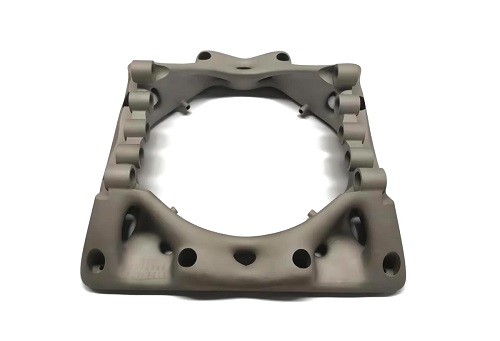
Brackets and fittings follow the same pattern. Traditional machined brackets start as solid blocks, with 90% of material cut away as chips. Printed brackets use only the material needed, with lattice structures replacing solid sections where loads allow. Weight reductions of 40-60% appear routinely, directly improving fuel efficiency.
A commercial aircraft with 10,000 printed brackets saves about 15% fuel consumption compared to conventionally equipped versions. Over a 20-year service life, that's millions in operating cost savings.
Medical Implants: Custom-Fit Perfection
Patient-specific implants represent SLM's most personally impactful application. Starting from CT scan data, engineers design implants matching each patient's anatomy exactly.
Titanium knee replacements printed via SLM show remarkable results. A 2024 study reported 95% patient satisfaction—far exceeding the 70-80% typical for standard implants. Why? Perfect fit means natural joint movement and reduced pain.
The real innovation lies in porous surface structures. SLM creates controlled porosity that mimics natural bone architecture. Bone grows into these pores, creating biological fixation rather than just mechanical anchoring. Studies show 40% higher osseointegration rates compared to solid implants.
Cranial plates, spinal cages, and dental frameworks follow similar paths. Each implant unique, each optimized for its recipient.
Automotive Prototyping: Speed to Market
Ford's EV battery housing development shows SLS at its best. Traditional prototyping required 8 weeks for tooling and machining. With SLS, they now iterate designs in 3 days. That's 95% time reduction, enabling multiple design cycles in the time one used to take.
Engine components benefit from SLM's cooling channel capabilities. Conformal cooling channels—curved passages following part geometry—replace straight drilled holes. This improves thermal efficiency by 25% in printed components, meaning better fuel economy and longer part life.
Lightweight brackets throughout vehicles reduce overall weight. Every kilogram saved extends electric vehicle range or improves conventional vehicle efficiency. SLS-printed nylon brackets with carbon fiber reinforcement match aluminum strength at half the weight.
Which Technology Should You Choose?
Decision Framework for SLS
Choose SLS when:
- Parts need strength but not extreme temperatures
- You're making functional prototypes or end-use polymer parts
- Complex geometries require support-free printing
- Production volumes range from one to hundreds
- Surface finish requirements are moderate
Best applications:
- Ductwork and housings
- Living hinges and snap-fits
- Medical models and surgical guides
- Automotive interior components
- Consumer goods prototypes
Decision Framework for SLM
Choose SLM when:
- Metal parts are required
- High strength and temperature resistance matter
- Full density (no porosity) is essential
- Complex internal features need precise control
- Weight optimization justifies higher cost
Best applications:
- Aerospace brackets and structural parts
- Medical implants with porous surfaces
- Tooling with conformal cooling channels
- Heat exchangers with complex passages
- High-performance automotive components
Cost Considerations
SLS parts typically cost $5-50 each for small-to-medium polymer components in low volumes. Material efficiency runs high—unsintered powder recycles for future builds. Setup costs remain low since no tooling required.
SLM metal parts run $50-500+ depending on size and material. Titanium costs more than stainless steel. Support structures add material waste and removal labor. Post-processing machining adds another 20-50% to total cost.
The economic sweet spot for both technologies lies in low-to-medium volumes (1-1,000 parts) with high complexity. Simple parts in high volumes still belong to traditional methods.
Yigu Technology's Experience
In our work at Yigu technology, we've applied SLS and SLM across dozens of client projects. The patterns are clear.
A medical startup needed 50 custom surgical guides for a clinical trial. Traditional machining would cost $800 each and take 3 weeks. SLS printed them for $120 each in 4 days. The trial started on schedule, and design changes during the process cost nothing extra.
An aerospace supplier required titanium brackets with weight limits impossible to machine. SLM produced parts at 42% of original weight while exceeding strength requirements. Each bracket cost more than machined versions, but the fuel savings over the aircraft's life paid back the premium 14 times over.
An automotive engineer redesigned an intake manifold with internal flow-optimized passages. SLS printed 12 design iterations in 3 weeks. Traditional prototyping would allow 2 iterations in the same time. The final design outperformed the original by 18%.
These aren't special cases. They're becoming the new normal.
Conclusion
Selective Laser Sintering and Selective Laser Melting aren't just improving manufacturing—they're redefining what's possible. SLS brings design freedom to polymer parts, enabling complex geometries without tooling costs. SLM delivers fully dense metal components with performance matching or exceeding conventional methods.
The choice between them isn't about which is "better." It's about matching the technology to the need. SLS for functional polymers, rapid iteration, and support-free complexity. SLM for metal parts, extreme environments, and weight-optimized structures.
Industries adopting these technologies gain advantages that compound over time. Faster development cycles mean more innovation. Lighter components mean better performance. Customized parts mean happier customers.
The fusion happening here isn't just technological—it's practical. These tools work today, delivering real value across aerospace, medical, automotive, and beyond. The question isn't whether to adopt them. It's how soon.
FAQ
What are the main differences between SLS and SLM in material processing?
SLS sinters polymer powders (partial melting) creating slightly porous parts with good strength. SLM fully melts metal powders into solid, dense components (99%+ density). SLS works with plastics and composites; SLM works with metals and alloys.
Can SLS and SLM be used for large-scale production?
Yes, but with limits. Industrial systems like the EOS M 400-4 handle build volumes up to 400x400x400mm, suitable for batch production. For very high volumes (10,000+ parts), traditional methods often remain more economical unless part complexity justifies additive.
Which industries benefit most from these technologies?
Aerospace gains lightweight components and complex geometries impossible to machine. Medical benefits from patient-specific implants with porous surfaces that promote bone growth. Automotive accelerates prototyping and creates optimized engine parts with conformal cooling.
How accurate are SLS and SLM parts?
SLM typically achieves ±0.05mm accuracy with 20-50μm layer thickness. SLS runs slightly less precise at ±0.1-0.2mm with 80-120μm layers. Both exceed requirements for most applications, though critical dimensions on SLM parts often receive final machining.
What post-processing do printed parts need?
SLS parts need powder removal and sometimes surface smoothing. SLM parts almost always require support removal and often CNC machining for critical surfaces. Heat treatment relieves residual stresses in metal parts. Surface finishing (polishing, coating) depends on application requirements.
Contact Yigu Technology for Custom Manufacturing
Ready to explore how SLS and SLM can transform your products? At Yigu technology, we bridge the gap between these advanced technologies and practical manufacturing needs. Our team works with you to select the right process, optimize designs for additive manufacturing, and deliver quality parts on schedule.
We offer:
- Free project consultations
- SLS and SLM printing services
- Design optimization for additive manufacturing
- Material selection guidance
- Post-processing including CNC machining
Stop wondering if your complex design is possible. [Contact Yigu Technology] today and let's make it real.