1. Horizontal machining center: the "core equipment" of modern precision manufacturing
In high-end industries such as aerospace and automobile manufacturing, high-precision machining of complex parts has always been a pain point in the industry. The horizontal machining center has become the key equipment to solve this problem with its horizontal spindle structure and multi-axis linkage. It can not only achieve multi-sided processing and mass production, but also greatly improve production efficiency through automation integration, and has now become an important indicator of the technical level of the manufacturing industry.
2. Basic cognition: the core definition and structure of horizontal machining center
(1) What is a horizontal machining center?
The definition of horizontal machining center is: a CNC machine tool with the spindle axis set parallel to the worktable, equipped with an automatic tool change system and a multi-station pallet, which can continuously complete multiple processes such as milling, boring, drilling, and tapping. Compared with vertical machining centers, its horizontal spindle design is more suitable for processing large box parts, avoiding the problem of gravity interference during vertical equipment processing.
(2) Core structure: the key components that determine the processing capacity
- Horizontal spindle structure: The spindle is arranged horizontally, and the tool magazine realizes automatic switching of multiple tools, with a spindle speed of up to 10000-20000rpm (high-speed models) and a torque covering 50-1000N·m to meet different cutting needs.
- Pallet exchange system: divided into two types: double pallet and multiple pallets (4-12 pallets), the workpiece is automatically exchanged through hydraulic or electric drive, and the pallet change time is only 10-30 seconds, greatly reducing the waiting time for clamping.
- 4-axis / 5-axis machining mechanism: 4-axis machining includes X/Y/Z linear axis + A-axis (table rotation), while 5-axis machining adds B-axis (spindle swing) or C-axis (table rotation) for complex surfaces and multi-sided parts.
3. Core advantages: Why is it the first choice for precision manufacturing?
(1) High-precision processing: micron-level error control
High-precision machining is the core competitiveness of horizontal machining centers, with positioning accuracy of up to ±0.005mm and repeat positioning accuracy of ±0.002mm. This is made possible by:
- The machine bed is made of cast iron or granite to reduce vibration and thermal deformation;
- Equipped with a raster scale closed-loop detection system to correct motion errors in real time;
- Case: An aerospace company uses a five-axis horizontal machining center to process titanium alloy structural parts, with a hole tolerance controlled at ±0.003mm, meeting the stringent requirements of aircraft parts.
(2) High-efficiency production: multi-process centralization and automation integration
- Multi-sided machining advantages: One clamping can complete the four-sided or five-sided machining of parts, avoiding errors caused by multiple clamping, and the processing efficiency is 30-50% higher than that of traditional equipment.
- Automation integration: It can form a flexible manufacturing unit (FMC) with robots, AGV trolleys, and warehousing systems to automate the whole process from blank to finished product, suitable for scenarios with high cycle time requirements for mass production.
- Data support: After introducing a multi-pallet HMC production line in an auto parts factory, the engine block processing cycle time was shortened from 45 minutes per piece to 22 minutes per piece, and the production capacity increased by 104%.
(3) Processing of complex parts: breaking through the limitations of traditional processes
For difficult workpieces such as complex box parts, hydraulic valve bodies, and large bearing housings, horizontal machining centers can achieve continuous cutting of spatial curved surfaces through five-axis linkage technology. For example, when processing aero engine blades, the five-axis linkage horizontal equipment can simultaneously control the X/Y/Z/B/C five-axis motion to perfectly reproduce the complex curved contours of the blades.
4. Equipment types and key technologies: unlock the processing limit
(1) Comparison of mainstream equipment types
| Device type | Core features: | Applicable scenarios |
| Horizontal boring and milling machining centers | High torque, high rigidity | Heavy machinery frame, large box processing |
| Multi-pallet HMC | Multi-station continuous processing | Mass production of auto parts and electronic components |
| High-speed horizontal processing | High spindle speed and fast feed | Precision mold, thin-walled parts processing |
| Five-axis linkage horizontal | Multi-axis collaboration, space machining | Aerospace structural parts, complex curved parts |
(2) Core technology analysis
- B-axis rotation technology: The spindle can swing around the Y axis (angle range ±90°), and rotate with the table to realize the processing of parts at any angle, which is the core guarantee of multi-sided processing.
- CNC system: The mainstream uses FANUC 31i and Siemens 840D systems, which support five-axis linkage control and tool path optimization, with a calculation speed of up to 1000 pieces per second to ensure accurate execution of machining instructions.
- Direct drive spindle technology: The motor directly drives the spindle, reducing transmission errors, increasing spindle rigidity by 20%, and reducing vibration during high-speed cutting, suitable for precision parts processing.
- Thermal deformation compensation: Real-time monitoring of temperature changes in various parts of the machine tool through temperature sensors, automatically correcting the position error of the spindle and worktable, and the compensation accuracy reaches ±0.001mm, solving the problem of accuracy drift in long-term processing.
- Dual table technology: two tables work alternately, one is clamped during processing, and the table change time is ≤ 15 seconds, greatly improving equipment utilization.
5. Application industries and typical parts: empowering high-end manufacturing
(1) Aerospace: Creating an "precision skeleton" for aircraft
Aerospace structural parts (such as aircraft girders and engine receivers) are mostly made of titanium alloys and superalloys, with complex structures and extremely high precision requirements. An aerospace company uses a five-axis linkage horizontal machining center to achieve one-time forming of deep holes, curved surfaces, and threads when processing engine receivers, with a machining accuracy of IT5 and a pass rate of 99.5% from 82% of the traditional process.
(2) Automobile manufacturing: the precision manufacturer of the "heart" of the automobile
Automobile engine block and gearbox housing are the main processing objects of horizontal machining centers. After a car company introduced a multi-pallet HMC production line, the cylinder block processing was fully automated, with an annual output of up to 500,000 units, a 18% reduction in processing costs, and a dimensional consistency error controlled within ±0.01mm.
(3) Energy equipment: ensure the stable output of energy power
In wind power and nuclear power equipment, energy equipment components (such as wind power gearbox housings and nuclear power flanges) need to withstand huge loads and have strict requirements for processing accuracy and rigidity. Horizontal boring and milling machining centers can efficiently process large parts made of high-strength steel with high-torque cutting technology (maximum torque up to 1000N·m) to ensure stable equipment operation.
(4) Other industry applications
- Mold manufacturing: Processing large injection mold cavities with surface roughness up to Ra0.8μm;
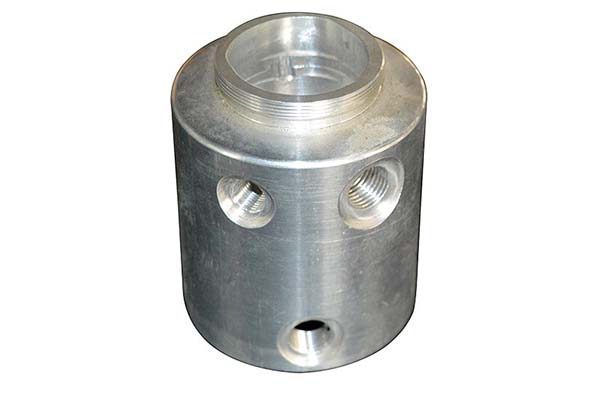
- Hydraulic industry: Processing hydraulic valve bodies with a bore tolerance of ±0.005mm to ensure the sealing performance of the hydraulic system.
6. Process design and production management: improve processing efficiency
(1) Fixture design and clamping scheme
The design of the fixture should follow the principle of "accurate positioning, reliable clamping, and convenient loading and unloading":
- Modular fixtures are used to adapt to different specifications of parts and reduce mold change time.
- For thin-walled parts, the elastic clamping method is used to avoid clamping deformation;
- Example: When machining a gearbox housing, a hydraulic clamp is used to achieve three-point positioning, the clamping force is evenly distributed, and the clamping time is reduced from 8 minutes to 2 minutes.
(2) Key process optimization skills
- Multi-process centralized processing: integrate milling, boring, drilling, tapping and other processes to reduce the number of clamping times and reduce the cumulative error.
- Cutting parameter optimization: Adjust the cutting speed, feed rate, and cutting depth according to the material (e.g., when processing 45 steel, the cutting speed is 80-120m/min, the feed rate is 0.2-0.5mm/r), and the tool life is extended by 30%.
- Tool management and path planning: Adopt tool life management system to monitor tool wear in real time; Optimize tool paths with CAM software to reduce empty strokes and improve machining efficiency.
- Precision testing and quality control: Introduce coordinate measuring instruments and online inspection systems to detect key dimensions in real time during the processing process, and correct errors in time.
(3) Flexible manufacturing unit (FMC) integration
Integrate multiple horizontal machining centers with robots, AGVs, and warehousing systems to realize:
- automatic loading and unloading and transfer of workpieces;
- Multi-equipment collaborative processing, increasing production capacity by 40%;
- Remotely monitor production status and reduce manual intervention.
7. Yigu Technology's view
Yigu Technology believes that horizontal machining centers are the core support of high-end manufacturing, and their technological iterations directly promote industrial upgrading. In the future, the "intelligent integration" and "process adaptability" of equipment will become the key to competition. When selecting a model, enterprises need to combine their own processing needs, balance accuracy, efficiency and cost, and pay attention to the automation compatibility of equipment. We will also continue to deepen CNC technology, promote the development of horizontal machining centers in a more efficient, precise and environmentally friendly direction, and help the manufacturing industry break through technical bottlenecks.
8. FAQ
- What is the core difference between horizontal machining centers and vertical machining centers?
Answer: the core difference is in the direction of spindle layout, horizontal spindle horizontal, suitable for large boxes and multi-sided parts processing; The vertical spindle is vertical, which is more suitable for flat plate and small parts processing. The horizontal equipment has stronger multi-pallet and multi-axis linkage capabilities, and the processing efficiency and accuracy are better.
- What are the applicable scenarios of 5-axis linkage horizontal machining center?
A: It is mainly used in aerospace structural parts, complex curved parts, precision molds and other scenarios that require multi-faceted/space processing, which can complete complex processes at one time and reduce clamping errors.
- How to improve the productivity of horizontal machining centers?
A: By optimizing cutting parameters, adopting multi-pallet systems, integrating automation equipment, optimizing tool paths, etc., equipment maintenance can be done at the same time to reduce downtime.
- What is the accuracy of horizontal machining centers?
Answer: The positioning accuracy of ordinary horizontal machining centers is ±0.005mm, and the high-end five-axis models can reach ±0.002mm.