Introduction
A decade ago, 3D printing was a niche hobby. Today, it is reshaping manufacturing. And at the center of this shift is a material made from corn starch: PLA.
Polylactic Acid (PLA) is the most widely used 3D printing filament. It is cheap. It is easy to print. It is made from renewable resources. But its impact goes far beyond hobbyist workbenches. PLA 3D printing is driving real change in automotive, aerospace, medical, and consumer goods manufacturing.
The global 3D printing market is growing fast—from $15.3 billion in 2020 to a projected $51.4 billion by 2026. PLA is a major part of this growth. In this guide, we will explore how PLA works, why it matters, and how industries are using it to manufacture better, faster, and more sustainably.
What Is PLA and Why Does It Matter?
A Plastic from Plants
PLA is short for Polylactic Acid. Unlike most plastics, which come from petroleum, PLA is made from renewable feedstocks. Corn starch, sugarcane, and cassava are the most common sources.
The production process is straightforward:
- Plants are harvested and starches are extracted
- Starches are fermented into lactic acid
- Lactic acid is polymerized into PLA
Key fact: PLA production uses 65 percent less energy than traditional petroleum-based plastics and produces fewer greenhouse gas emissions.
Basic Properties
| Property | Value | Implication |
|---|---|---|
| Melting point | 150–160°C | Low energy to print |
| Glass transition | 60–65°C | Not for high-heat applications |
| Tensile strength | 40–70 MPa | Moderate strength |
| Biodegradability | Industrial composting | Environmentally friendly end-of-life |
What Are the Key Advantages of PLA?
Biodegradability
PLA is biodegradable—under the right conditions. In an industrial composting facility (with temperatures around 60°C and specific microbes), PLA breaks down in 6 to 12 months.
Comparison: ABS shows no degradation even after 5 years in the same conditions.
This makes PLA ideal for:
- Short-lifecycle products
- Disposable prototypes
- Packaging applications
- Educational models
Real-world example: A university lab prints disposable surgical training models in PLA. After use, the models go to industrial composting instead of landfills.
Renewable Feedstocks
PLA is made from plants, not oil. This matters for several reasons:
| Aspect | Petroleum Plastics | PLA |
|---|---|---|
| Resource | Finite, geopolitically sensitive | Renewable, local agriculture |
| Price volatility | Tied to oil prices | More stable |
| Carbon footprint | High | Lower |
Key fact: PLA production can support local agriculture. In the United States, corn-based PLA has created an additional market for farmers.
Printability
PLA is the easiest 3D printing material to work with.
- Low warping – No heated bed required for small parts
- Low odor – Unlike ABS, no strong fumes
- Wide temperature range – Prints well from 180–220°C
- Good adhesion – Sticks to most build surfaces
Cost-Effectiveness
PLA filaments are typically 20 to 50 percent cheaper than specialized materials like polycarbonate or nylon. A standard 1 kg spool costs $20–$30. This low cost enables:
- Rapid iteration without budget constraints
- Educational programs with limited funding
- Prototyping for startups and small businesses
What Are the Limitations of PLA?
Mechanical Properties
PLA is not the strongest plastic. Its limitations matter for certain applications.
| Property | PLA | ABS | Polycarbonate |
|---|---|---|---|
| Tensile strength | 40–70 MPa | 50–65 MPa | 60–70 MPa |
| Heat deflection | 60–65°C | 90–100°C | 130–140°C |
| Impact resistance | Low | High | Very high |
Key fact: PLA softens at temperatures as low as 60°C. A PLA part left in a car on a summer day will deform.
Biodegradation Conditions
PLA is biodegradable, but not in a backyard compost pile. It requires:
- Temperatures – Above 60°C
- Microbes – Specific to industrial composting
- Humidity – Controlled conditions
In a standard landfill, PLA degrades very slowly—minimal signs after 3 years. Proper disposal in industrial composting facilities is essential for environmental benefits.
What 3D Printing Technologies Use PLA?
Fused Deposition Modeling (FDM)
FDM is the most common PLA printing technology. It works by melting filament and extruding it through a nozzle.
Working principle:
- Filament is fed into a heated nozzle (180–220°C)
- Nozzle moves in X and Y, depositing melted plastic
- Build platform lowers after each layer
- Plastic cools and solidifies almost immediately
Applications:
- Rapid prototyping
- Educational models
- Consumer products
- Jigs and fixtures
Advantages:
- Low equipment cost (desktop printers from $200)
- Simple operation
- Easy maintenance
Real-world example: A product designer prints five iterations of a new kitchen tool handle in PLA. Each iteration costs $3 in material and prints overnight. The final design is validated in one week.
Stereolithography (SLA)
SLA uses light to cure liquid resin. Some resins contain PLA components.
Working principle:
- UV laser or projector cures liquid resin layer by layer
- Build platform moves up or down
- Resin solidifies where light hits
Applications:
- High-detail models
- Jewelry patterns
- Dental models
- Medical anatomical models
Advantages:
- Layer thickness as low as 0.05 mm
- Smooth surface finish
- Fine detail capture
Selective Laser Sintering (SLS)
SLS uses a laser to fuse PLA powder.
Working principle:
- Thin layer of PLA powder is spread
- Laser sinters powder where part exists
- Build platform lowers, new powder spread
- Unsintered powder acts as natural support
Applications:
- Complex geometries
- Functional prototypes
- Small-batch production
Advantages:
- No support structures needed
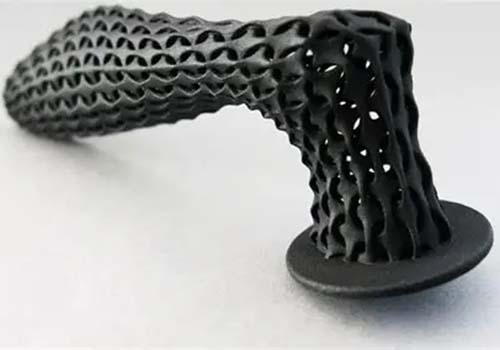
- Can create internal lattice structures
- Good mechanical properties
How Is PLA 3D Printing Used in Manufacturing?
Automotive Industry
Custom parts – BMW uses PLA 3D printing for custom interior components. Traditional mold costs can reach $50,000 per part. With 3D printing, custom parts cost 70 percent less and ship in days, not weeks.
Prototyping – Ford prints PLA prototypes for new car designs. A prototype that once took months now takes days. This has reduced development costs by 30 to 40 percent for new vehicle models.
Real-world example: An automotive aftermarket company prints custom spoilers for sports cars. Each design is low volume—10 to 50 units. PLA printing makes production cost-effective without tooling.
Aerospace Industry
Lightweight components – PLA printed parts with lattice structures reduce weight while maintaining strength. A study found that using PLA lattice components in a UAV reduced weight by 15 to 20 percent and increased flight endurance by 25 to 30 percent.
Tooling and jigs – Boeing uses PLA printed jigs for aircraft assembly. Traditional metal jigs cost 30 to 50 percent more and take weeks to produce. PLA jigs are printed overnight. If a design changes, a new jig prints the next day.
Key fact: PLA jigs on Boeing assembly lines have reduced assembly time by 10 to 15 percent.
Medical Industry
Surgical models – Surgeons use PLA printed models to plan complex procedures. A patient’s CT scan becomes a physical model. Surgeons rehearse on the model before touching the patient.
Custom prosthetics – PLA printing enables low-cost, custom-fit prosthetics. A traditional prosthetic can cost $5,000 to $50,000. A PLA printed version can cost $50 to $500 and be tailored to the patient’s anatomy.
Real-world example: A children’s hospital uses PLA to print custom hand prosthetics for young patients. As the child grows, a new prosthetic prints in days at minimal cost.
Consumer Goods
Rapid prototyping – Companies test new product ideas with PLA prototypes before committing to expensive molds.
Custom products – Small businesses use PLA printing to offer personalized products. A jewelry designer prints custom pendants. A toy maker prints limited-edition figures.
What Does the Future Hold?
Material Advancements
PLA blends are expanding the material’s capabilities.
| Blend | Property Improvement |
|---|---|
| PLA + wood | Aesthetic, biodegradable composites |
| PLA + carbon fiber | Increased stiffness |
| PLA + metal powder | Metallic appearance, higher density |
| PLA + elastomers | Flexibility |
Sustainability Focus
As companies seek to reduce their environmental impact, PLA’s renewable origins become more valuable. Combined with proper composting infrastructure, PLA offers a path to truly sustainable manufacturing.
Hybrid Manufacturing
The future is not PLA replacing all materials. It is using PLA where it fits:
- Prototyping before production materials
- Low-heat, low-stress applications
- Short-lifecycle products
- Educational and medical models
Yigu Technology’s View
At Yigu Technology, we use PLA 3D printing daily. It is often the first step in a project—fast, cheap, and reliable.
Case Study: Medical Training Models
A medical school needed 50 anatomical models for a new training course. Each model had delicate internal structures. Traditional manufacturing would have cost $5,000 and taken six weeks.
We printed the models in PLA using SLA. The high-detail resin captured every internal feature. Total cost was $800. Delivery was one week. The school now orders new models annually.
Case Study: Automotive Tooling
An automotive supplier needed custom assembly fixtures for a new production line. Traditional machined fixtures cost $3,000 each and took three weeks.
We printed the fixtures in PLA using FDM. Cost per fixture: $200. Lead time: three days. The fixtures lasted through the entire production run.
Our Approach
We use PLA for:
- Rapid prototypes
- Tooling and fixtures
- Low-stress end-use parts
- Models and visual aids
When a project requires higher strength or heat resistance, we move to nylon, polycarbonate, or metal. But PLA is often the right starting point.
Conclusion
PLA 3D printing is driving a revolution in manufacturing. It offers a unique combination of low cost, ease of use, and environmental benefits. It enables rapid prototyping that once took months. It allows custom manufacturing without expensive tooling. It brings medical models and prosthetics to patients who need them.
PLA has limitations. It is not for high-heat or high-stress applications. But for the vast middle ground of prototyping, tooling, and low-volume production, it is the material of choice.
As manufacturing becomes more distributed, more customized, and more sustainable, PLA will play an increasingly important role. It is not the only material. But it is a material that opens doors.
FAQ
What is PLA and why is it so popular in 3D printing?
PLA (Polylactic Acid) is a biodegradable plastic made from renewable resources like corn starch. It is popular because it is easy to print (low warping, no heated bed required), low cost ($20–$30 per kg), and environmentally friendly compared to petroleum-based plastics.
How does PLA compare to ABS for 3D printing?
PLA is easier to print, produces less odor, and is biodegradable. ABS is stronger, more heat resistant (90–100°C vs. 60–65°C), and more durable. Choose PLA for prototypes and low-stress parts. Choose ABS for functional parts that need durability or heat resistance.
Is PLA truly biodegradable?
Yes, but under specific conditions. PLA requires industrial composting with temperatures above 60°C and specific microbes to biodegrade. In a standard landfill, it degrades very slowly. Proper disposal is essential for environmental benefits.
Contact Yigu Technology for Custom Manufacturing
Need PLA 3D printing for prototypes, tooling, or low-volume production? Yigu Technology offers professional FDM, SLA, and SLS services with a range of PLA materials.
Contact us today to discuss your project. From concept to production, we help you bring ideas to life.