Introduction
Threads are everywhere. They hold together the engine in your car, secure the bolts in a jet engine, and ensure that a surgical implant stays in place. These helical grooves—internal like those in a nut or external like those on a bolt—are fundamental to mechanical assembly. But creating precise, reliable threads is not simple. It requires specialized tools, careful process control, and a deep understanding of thread geometry.
Thread machining is the manufacturing process that creates these essential features. Whether through tapping, threading, or turning, the goal is the same: produce threads with the correct pitch, profile, and tolerance to ensure secure connections, precise adjustments, and reliable performance. This guide explores the methods, tools, machinery, and applications of thread machining.
Why Is Thread Machining Important?
Threads are critical to modern manufacturing. They enable:
- Secure connections: Fastening components together reliably
- Precise adjustments: Fine-tuning mechanical systems
- Power transmission: Converting rotational motion to linear motion (lead screws)
- Ease of assembly/disassembly: Allowing maintenance and repair
The quality of threads directly impacts the strength and reliability of threaded connections. Poorly machined threads can lead to:
| Issue | Consequence |
|---|---|
| Stripped threads | Loose connections, failure under load |
| Improper fit | Assembly difficulties, misalignment |
| Surface defects | Stress concentrations, fatigue failure |
In industries like aerospace and medical, where safety is paramount, high-precision threads are non-negotiable. Even minor deviations can have significant consequences.
What Are the Main Methods of Thread Machining?
There are three primary methods for machining threads: tapping, threading, and threading by turning. Each is suited to different applications.
Tapping: Internal Threads
Tapping is the most common method for creating internal threads (like those in nuts or threaded holes).
| Aspect | Details |
|---|---|
| Process | A tap (cutting tool with helical flutes) is rotated and advanced into a pre-drilled hole |
| Operation | Can be manual (tap wrench) or automated (tapping machine, CNC lathe) |
| Coolant | Essential to reduce friction, manage heat, flush chips |
| Applications | Engine blocks, transmission housings, landing gear assemblies |
Key consideration: Tap selection must match the hole size, thread pitch, and material. Using the wrong tap or improper speed can result in broken taps or damaged threads.
Threading: External Threads
Threading creates external threads (like those on bolts and screws) using a die or thread rolling die.
| Aspect | Details |
|---|---|
| Process | Die is fed onto a rotating cylindrical workpiece |
| Types | Cutting: Removes material to create threads; Forming: Deforms material without removal |
| Advantage of forming | Produces stronger threads with better surface finish; preferred for steel and aluminum |
| Applications | Bolts, screws, studs, threaded fasteners |
Comparison:
| Method | Material Removal | Thread Strength | Surface Finish |
|---|---|---|---|
| Cutting threading | Yes | Standard | Good |
| Forming threading | No | Higher (work-hardened) | Excellent |
Threading by Turning: Precision External Threads
Threading by turning uses a lathe with a single-point cutting tool to create threads on a rotating workpiece.
| Aspect | Details |
|---|---|
| Process | Single-point tool follows helical path along rotating workpiece |
| Equipment | CNC lathe with thread turning insert |
| Advantages | High precision, repeatability, complex thread geometries, tight tolerances |
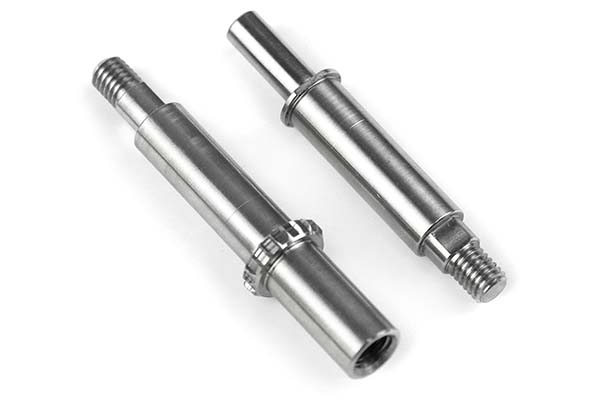
| Applications | Shafts, pins, medical implants, lead screws |
Why choose this method: Threading by turning is ideal for applications requiring custom thread profiles, large diameters, or materials where tapping or die threading is impractical. CNC control ensures precise pitch and depth.
What Tools and Machinery Are Used?
Thread machining requires specialized tools and equipment tailored to the method.
Taps and Dies
| Tool | Function | Types |
|---|---|---|
| Taps | Create internal threads | Hand taps, machine taps, spiral flute taps, spiral point taps |
| Dies | Create external threads | Adjustable dies, solid dies, thread rolling dies |
Materials: High-speed steel (HSS) for general use; carbide for high-volume or hard materials.
Threading Tools and Inserts
For threading by turning:
| Component | Function |
|---|---|
| Threading inserts | Replaceable cutting tips with specific thread profiles (60° UN, metric, etc.) |
| Tool holders | Mount inserts securely on turret or tool post |
| Chip breakers | Manage chip formation for clean threads |
Lathes and CNC Machines
| Machine Type | Capability |
|---|---|
| Manual lathe | Operator-controlled threading; suitable for small batches |
| CNC lathe | Automated, precise, repeatable; handles complex thread geometries; integrates multiple operations |
CNC advantage: Modern CNC lathes can perform turning, milling, and threading in a single setup, increasing efficiency and reducing handling errors.
Coolant Systems
Coolant is essential for tapping and threading operations:
| Function | Benefit |
|---|---|
| Reduce friction | Smooth cutting action |
| Manage heat | Prevents tool damage, extends life |
| Flush chips | Prevents interference with thread cutting |
Common coolants: Water-soluble oils, synthetic fluids, air mist systems.
What Are the Key Thread Specifications?
Threads are defined by several critical parameters:
| Parameter | Description | Example |
|---|---|---|
| Pitch | Distance between threads | 1.0 mm (metric), 20 TPI (UN) |
| Major diameter | Largest diameter of external thread | 10 mm |
| Minor diameter | Smallest diameter of external thread | 8.5 mm |
| Thread angle | Angle between thread flanks | 60° (metric, UN) |
| Thread form | Profile shape | UN, metric, Acme, Buttress |
| Tolerance class | Fit classification | 6H (internal), 6g (external) |
Example: M10 × 1.0 — 6g
- M = metric
- 10 = nominal diameter (mm)
- 1.0 = pitch (mm)
- 6g = tolerance class for external thread
What Industries Rely on Thread Machining?
Thread machining serves industries where threaded connections must perform reliably under demanding conditions.
Automotive Industry
| Application | Components |
|---|---|
| Engine | Cylinder head bolts, main bearing caps, spark plug threads |
| Transmission | Valve bodies, housing fasteners |
| Chassis | Suspension components, brake calipers |
Requirements: High-volume production, consistent quality, strength under cyclic loading.
Aerospace Industry
| Application | Components |
|---|---|
| Airframe | Structural fasteners, wing attachment bolts |
| Engine | Turbine mounting bolts, casing fasteners |
| Landing gear | High-strength threaded components |
Requirements: Extreme precision, full traceability, AS9100 certification, materials like titanium and superalloys.
Medical Industry
| Application | Components |
|---|---|
| Implants | Bone screws, dental implants, spinal rods |
| Surgical instruments | Threaded handles, locking mechanisms |
| Diagnostic equipment | Precision adjustment mechanisms |
Requirements: Biocompatible materials, micron-level precision, ISO 13485 certification, smooth surfaces to prevent tissue damage.
Construction and Piping
| Application | Components |
|---|---|
| Plumbing | Pipe threads (NPT, BSP), fittings |
| Structural | Anchor bolts, threaded rods |
| Mechanical | Flange connections, valve stems |
Requirements: Corrosion resistance, leak-proof seals, durability in harsh environments.
General Manufacturing
| Application | Components |
|---|---|
| Fasteners | Bolts, screws, nuts, studs |
| Machinery | Lead screws, adjustment screws |
| Assemblies | Threaded inserts, couplings |
Requirements: Versatility, cost-effectiveness, ability to handle various materials and volumes.
Conclusion
Thread machining is a fundamental manufacturing process that creates the helical grooves essential to mechanical assembly. Through tapping (internal threads), threading (external threads with dies), and threading by turning (precision threads on CNC lathes), manufacturers produce threads that meet the demanding requirements of automotive, aerospace, medical, and industrial applications.
Success in thread machining depends on:
- Selecting the right method for the application
- Using appropriate tools (taps, dies, threading inserts)
- Maintaining precise control of cutting parameters
- Employing effective cooling and chip management
- Adhering to thread specifications (pitch, diameter, tolerance)
When done correctly, thread machining produces connections that are strong, reliable, and precise—enabling the assemblies that power modern industry.
FAQs
What are the main methods of thread machining?
The three main methods are: tapping (creating internal threads with a tap), threading (creating external threads with a die or thread rolling die), and threading by turning (using a lathe with a single-point cutting tool to create precision external threads). Each method is suited to different applications, materials, and precision requirements.
Which industries rely heavily on thread machining?
Thread machining is essential in automotive (engine and transmission components), aerospace (structural fasteners, engine parts), medical (implants, surgical instruments), construction and piping (pipe threads, fittings), and general manufacturing (fasteners, machinery components). Any industry requiring threaded connections depends on high-quality thread machining.
What are the key tools and machinery used in thread machining?
Key tools include taps (for internal threads), dies (for external threads), and threading inserts (for lathe threading). Primary machinery includes manual lathes, CNC lathes, and tapping machines. Coolant systems are essential for reducing friction, managing heat, and flushing chips during operations.
What is the difference between cutting and forming threads?
Cutting threads removes material to create the thread profile—standard method, works with most materials. Forming threads deforms the material without removal—work-hardens the surface, producing stronger threads with better surface finish. Forming is often preferred for steel and aluminum where strength is critical.
What thread specifications should I consider?
Key specifications include pitch (distance between threads), major and minor diameters, thread angle (typically 60° for metric and UN threads), thread form (UN, metric, Acme, Buttress), and tolerance class (e.g., 6H for internal, 6g for external). These parameters determine fit, strength, and functionality.
Contact Yigu Technology for Custom Manufacturing
At Yigu Technology, we specialize in precision thread machining for demanding applications. With 15 years of experience, advanced CNC turning capabilities, and ISO 9001 certification, we deliver threaded components that meet the tightest tolerances.
Our capabilities include tapping, threading, and threading by turning for internal and external threads across materials from aluminum and steel to titanium and medical-grade plastics. We work with standard and custom thread profiles to meet your application requirements. Contact us today to discuss your threaded component project.