Introduction
You have an idea for a product. You need a prototype. Maybe you need a small production run, or a custom part that doesn't exist. In the past, this meant months of waiting, expensive tooling, and minimum order quantities that made no sense for a single item. 3D printing shops have changed everything. These service bureaus turn digital designs into physical objects in days, enabling on-demand manufacturing that responds to customer needs in real-time. From startups testing new concepts to established companies producing custom parts, 3D printing shops are transforming how products are designed, prototyped, and manufactured. This guide explores how these shops work, the technologies they use, and how they're shaping the future of on-demand manufacturing design.
What Are 3D Printing Shops?
Definition and Core Concept
3D printing shops (also called 3D printing service bureaus) are establishments that offer a range of 3D printing-related services to customers. They bridge the gap between digital design and physical reality, turning ideas into objects.
Services typically include:
| Service Type | Description | Example Applications |
|---|---|---|
| Printing Services | Using various 3D printing technologies (FDM, SLA, SLS, metal) to create physical objects from digital models | Prototyping, custom jewelry, dental prosthetics, manufacturing aids |
| Equipment and Material Sales | Selling 3D printers (desktop to industrial) and printing materials | Home users, businesses expanding in-house capabilities |
| Design and Consultation | Helping customers create 3D models, advising on technology and material selection | Startups, individuals with ideas but no design skills |
Why They Matter
3D printing shops democratize access to advanced manufacturing:
- No capital investment: Access industrial-grade equipment without buying it
- Expertise on demand: Tap into knowledge of materials, technologies, and processes
- Scalability: From one prototype to hundreds of parts
- Speed: Turnaround in days instead of weeks or months
How Do 3D Printing Shops Work?
The Working Process
Step 1: Receiving the Design File
The process begins when a customer submits a 3D model. Common file formats include:
- STL (Stereolithography) : Most common
- OBJ (Object File) : Often includes color/texture data
- 3MF (3D Manufacturing Format) : Modern, more robust
The shop's staff performs an initial check for errors:
- Non-manifold geometry (surfaces that don't meet properly)
- Holes or gaps in the model
- Incorrect scaling
- Wall thickness issues
Industry fact: About 15–20% of received models require some repair or adjustment at this stage.
Step 2: Slice Processing
The approved model is processed through slicing software, which:
- Divides the model into thin horizontal layers
- Generates G-code instructions for the printer
- Sets parameters like layer height, infill density, and supports
Key parameters:
- Layer height: 0.1–0.3 mm typical. Smaller = smoother but slower.
- Infill density: 20–30% for non-structural parts; 50–100% for load-bearing.
Step 3: Printing
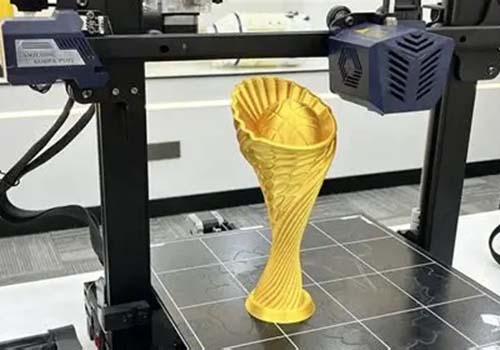
The G-code is sent to the appropriate 3D printer. Printing time varies:
- Small FDM part: hours
- Large complex SLS part: days
Step 4: Post-Processing
Printed objects require finishing:
- Support removal: Breaking or dissolving temporary structures
- Sanding: Smoothing surfaces, removing layer lines
- Cleaning: Removing uncured resin (for SLA)
- Curing: UV exposure for resin parts
- Painting/coating: Aesthetic or protective finishes
What Is On-Demand Manufacturing?
The Concept
On-demand manufacturing (also called "build-to-order" or "pull-based" manufacturing) produces products only when a confirmed order exists. This contrasts with traditional "push-based" manufacturing, which mass-produces and stores inventory in anticipation of demand.
How it works:
- Customer submits a design (often through an online platform)
- Design transmits instantly to a manufacturing facility
- Digital tools (3D printers, CNC machines) create the physical product
- Product ships directly to customer
Advantages Over Traditional Manufacturing
| Factor | Traditional Manufacturing | On-Demand Manufacturing |
|---|---|---|
| Inventory | Large warehouses of finished goods | No inventory—print when ordered |
| Risk | Overproduction, unsold goods | Minimal—only what's ordered |
| Customization | Difficult, expensive | Easy—each part can be unique |
| Lead time | Weeks to months | Days |
| Minimum quantity | Often hundreds or thousands | One |
| Capital tied up | Significant in inventory | Minimal |
Why On-Demand Matters
- Reduced inventory costs: No warehouses, no unsold goods
- Less waste: No overproduction, no obsolete inventory
- Greater customization: Products tailored to individual customers
- Faster response: Adapt quickly to market changes
- Accessibility: Small businesses can compete without massive investment
How Are 3D Printing Shops Transforming On-Demand Manufacturing Design?
Design Freedom and Complex Geometries
Traditional manufacturing limits design. Machining requires tool access. Molding requires draft angles. Undercuts are difficult.
3D printing removes these limits:
- Internal cavities: Channels, passages, hollow spaces
- Lattice structures: Lightweight yet strong frameworks
- Organic shapes: Forms optimized for performance
- Undercuts and overhangs: No tool access needed
Real-world example: Aerospace components with internal cooling channels impossible to machine—now printed directly.
Customization Capabilities
Today's consumers want products tailored to them. 3D printing shops deliver:
Medical applications:
- Patient-specific implants designed from CT scans
- Custom prosthetics that fit perfectly
- Surgical guides for precise procedures
Consumer goods:
- Personalized jewelry with unique designs
- Custom-fit eyewear
- Phone cases with individual patterns
- Ergonomic products matched to user needs
Industrial applications:
- Tools designed for specific tasks
- Fixtures that fit unique workpieces
- Replacement parts for legacy equipment
Business impact: Customization creates differentiation, customer loyalty, and premium pricing.
Faster Prototyping
Prototyping is essential for product development. Traditional methods are slow:
- Creating molds takes weeks
- Machining requires setup and programming
- Changes mean starting over
With 3D printing shops:
- Prototypes in hours to days
- Multiple iterations in the time one traditional cycle would take
- Design changes cost nothing—just modify the file
Example: A smartphone case that took weeks with traditional methods can be prototyped overnight. Test ergonomics, button placement, thickness—iterate tomorrow.
Result: Faster time-to-market, better products, lower development costs.
Cost-Efficiency for Small-Batch Production
Traditional manufacturing economics punish small batches. Tooling costs—molds, dies, fixtures—can be thousands to hundreds of thousands of dollars. For runs of 100–1,000 parts, these costs make per-unit prices prohibitive.
3D printing changes this:
- No tooling costs
- Per-part cost relatively constant regardless of quantity
- Economical for batches from 1 to 1,000+
Comparison for 100 custom parts:
- Traditional injection molding: $15,000 mold + $5/part = $15,500
- 3D printing: $20/part × 100 = $2,000
Result: Startups can produce small batches. Established companies can test markets without risk. Custom products become viable.
What Technologies Do 3D Printing Shops Use?
| Technology | Materials | Strengths | Best For |
|---|---|---|---|
| FDM | PLA, ABS, PETG, nylon | Low cost, large parts, functional | Prototypes, jigs, fixtures, low-cost production |
| SLA | Photopolymer resins | High detail, smooth finish | Jewelry, dental models, visual prototypes |
| SLS | Nylon, TPU, composites | Durable, no supports | Functional parts, complex geometries |
| Metal (SLM/DMLS) | Titanium, stainless steel, aluminum | High strength, production-grade | Aerospace, medical, industrial |
| Material Jetting | Photopolymers | Multi-material, color, smooth | Visual prototypes, medical models |
| Binder Jetting | Metals, ceramics, sand | Fast, large build volumes | Metal parts, molds, casting patterns |
What Are the Benefits of Using 3D Printing Shops?
Access to Advanced Technology
Industrial-grade 3D printers cost $100,000–$1,000,000+ . Few businesses can justify this investment. 3D printing shops provide access without the capital cost.
Expertise on Demand
Shops employ experts who understand:
- Material properties and selection
- Printability and design optimization
- Post-processing techniques
- Quality assurance
This expertise means better results, fewer mistakes, and optimized outcomes.
Scalability
Need one prototype today and 100 parts next month? One shop can handle both. No need to find new vendors as quantities change.
Speed
No setup time, no tooling, no waiting. Parts print immediately. Rush orders possible. Development cycles compress.
Cost-Effectiveness
Pay only for what you need. No equipment to buy, no materials to inventory, no staff to train. Variable cost instead of fixed cost.
Focus on Core Business
Outsourcing manufacturing lets you focus on what you do best—design, marketing, sales, innovation.
How Do You Choose the Right 3D Printing Shop?
Key Factors to Consider
Technology range: Do they offer the right printers for your needs? FDM for large parts? SLA for detail? SLS for durability? Metal for production?
Material options: Can they print in the materials your project requires? Standard plastics? Engineering materials? Metals? Specialties?
Design expertise: Can they help with design? Do they review files for printability? Will they suggest improvements?
Post-processing capabilities: What finishing options do they offer? Sanding? Painting? Assembly? Heat treatment?
Quality assurance: Do they inspect parts? Provide documentation? Have guarantees?
Turnaround time: How fast can they deliver? Rush options?
Cost transparency: Clear quotes? Itemized breakdowns? No hidden fees?
Location: Local shops offer faster delivery, lower shipping costs, and face-to-face consultation. Global shops may offer lower prices or specialized capabilities.
Questions to Ask
- What 3D printing technologies do you offer?
- What materials can you print in?
- Can you review my file before printing?
- What post-processing services do you provide?
- How do you ensure quality?
- What is your typical turnaround time?
- Can you provide a detailed quote?
How Does Yigu Technology Approach 3D Printing Services?
As a non-standard plastic and metal products custom supplier, Yigu Technology operates as a comprehensive 3D printing shop, offering end-to-end services for on-demand manufacturing.
Our Services
Printing: Multiple technologies—FDM for large parts, SLA for detail, SLS for durability, metal for production-grade components.
Materials: Wide range—plastics, resins, metals. Expert guidance on selection.
Design: In-house designers help from concept to printable model. We optimize for printability, function, and cost.
Post-processing: Support removal, sanding, polishing, painting, heat treatment, assembly.
Quality: Every part inspected. Documentation provided. Guarantees on work.
Our Experience
Startup: Needed a product prototype quickly. Traditional approach would take weeks. We handled design, printing, and finishing in 5 days. Client iterated based on feedback—new version in another 5 days.
Medical device company: Required custom surgical guides. Each unique, each needed quickly. We managed design from CT data, printing in biocompatible resin, and finishing—all in-house. Surgeons received perfect parts in days.
Industrial manufacturer: Needed replacement parts for aging machinery. We scanned worn parts, designed replacements, printed in durable nylon, and finished. Machine back in service within a week.
Our Commitment
We believe in simplifying additive manufacturing. One point of contact, one team, one solution. From idea to finished part, we're with you every step.
Conclusion
3D printing shops are at the forefront of a manufacturing revolution, shaping the future of on-demand design and production:
- Design freedom: Complex geometries impossible with traditional methods
- Customization: Products tailored to individual needs
- Faster prototyping: Days instead of weeks or months
- Cost-effective small batches: No tooling, economical for low volumes
- Access to advanced technology: Industrial-grade capabilities without investment
- Expertise on demand: Knowledge and guidance at every step
Real-world impact:
- 15–20% of submitted models need repair—shops provide expertise to fix them
- Prototyping time reduced from weeks to days
- Small-batch production economically viable for 1–1,000 parts
- Customization enabling patient-specific medical devices, personalized consumer goods
For businesses and individuals, 3D printing shops democratize manufacturing. You bring the idea—they deliver the finished part.
The future of making things is on-demand, customized, and accessible. And 3D printing shops are leading the way.
Frequently Asked Questions
Q1: What are the most common 3D printing technologies used in 3D printing shops?
FDM (low cost, large parts, prototypes), SLA (high detail, smooth finish, jewelry/dental), SLS (durable parts, no supports, functional), and metal printing (high strength, production-grade) are most common. Choice depends on your application.
Q2: How can I ensure the quality of 3D-printed products from a 3D printing shop?
- Provide a high-quality, error-free 3D model
- Check the shop's reputation and reviews
- Discuss appropriate technology and materials for your project
- Inquire about post-processing and quality assurance
- Request samples of similar work
Q3: What are the typical costs associated with using a 3D printing shop?
Costs depend on:
- Printing: Material used, complexity, printing time
- Design services: Complexity of design work
- Materials: PLA inexpensive, specialty resins/metals costly
- Post-processing: Additional finishing adds cost
Get detailed quotes with itemized breakdowns.
Q4: How long does it take to get a part from a 3D printing shop?
Simple parts: 1–3 days. Complex parts: 3–7 days. Rush orders possible. Time includes design review, printing, and post-processing.
Q5: Can 3D printing shops handle both prototyping and production?
Yes. Many clients start with prototypes, then scale to small-batch production with the same provider. This ensures consistency and streamlines the transition.
Q6: Do I need a 3D model to use a 3D printing shop?
Yes—but if you don't have one, most shops offer design services. They can create a printable 3D model from your sketches, descriptions, or concepts.
Q7: What file formats do 3D printing shops accept?
STL is most common. Many also accept OBJ, 3MF, STEP, and native CAD files. Check with your provider.
Contact Yigu Technology for Custom Manufacturing
Ready to experience the power of on-demand manufacturing through 3D printing? At Yigu Technology, we provide comprehensive 3D printing services—from design to finished part. Our team guides you through every step, ensuring quality results on schedule.
Visit our website to see our capabilities. Contact us today for a free consultation and quote. Let's bring your designs to life—on demand.