Introduction
Lathe machining parts are everywhere. They spin inside jet engines, transferring power through turbine blades machined to tolerances within microns. They form the backbone of automotive drivetrains, transmitting torque through shafts with straightness measured in hundredths of a millimeter. They become surgical instruments, grasping tissue with jaws as fine as a human hair.
Since the industrial revolution, lathes have evolved. Today’s CNC lathes are a far cry from manual machines. They achieve precision that was once impossible. They operate with efficiency that transforms production economics.
This guide explores how lathe machining parts enhance modern manufacturing. You will learn about the technical principles, precision capabilities, industry applications, and the factors that make lathe machining indispensable. By the end, you will understand why lathe-machined components remain the cornerstone of precision manufacturing.
What Are the Technical Foundations of Lathe Machining?
Core Principles of Lathe Machining
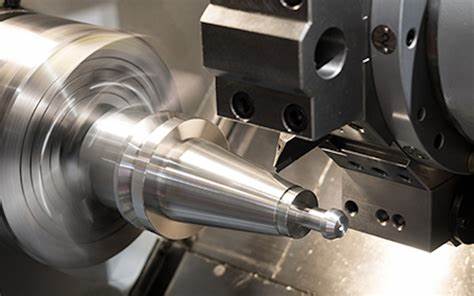
Lathe machining is a subtractive manufacturing process. The lathe rotates the workpiece while a cutting tool removes material to achieve the desired shape. Two primary motions work together:
Principal motion – The high-speed rotation of the workpiece. When machining aluminum alloys, spindle speeds can reach 10,000 RPM . This rotation determines cutting speed, which affects surface finish and material removal rate.
Feed motion – The linear movement of the cutting tool along the X (radial) and Z (longitudinal) axes. In modern CNC lathes, additional rotational axes (A and C) enable complex geometries.
These motions work in harmony. When cutting threads, the rotation of the workpiece synchronizes with the precise linear movement of the cutting tool to produce the correct pitch and form.
Evolution from Manual to CNC Lathes
The shift from manual to CNC lathes revolutionized manufacturing.
| Aspect | Manual Lathes | CNC Lathes | Improvement |
|---|---|---|---|
| Precision | ±0.05 mm | ±0.001–0.005 mm | 90% improvement |
| Production Time | 2–4 hours | 15–30 minutes | 80% reduction |
| Design Complexity | Simple cylindrical parts | Helical threads, tapers, undercuts | Unlimited design freedom |
| Material Removal Rate | 50 cm³/min | 200 cm³/min | 300% increase |
A 2025 report by the Precision Machining Technology Association (PMTA) found that CNC lathes reduce human error by 75% , making them indispensable for high-precision applications.
How Does Precision Drive Efficiency in Lathe Machining?
Dimensional Tolerance and Surface Finish
Dimensional tolerance and surface finish define part quality.
Dimensional tolerance – Acceptable deviation from specified dimensions. For high-precision applications, tolerances can be as tight as ±0.001 mm .
In semiconductor manufacturing equipment, lathe-machined components for wafer handling systems require extremely tight tolerances. A study by the Semiconductor Equipment and Materials International (SEMI) found that a 10% reduction in dimensional tolerance leads to a 20% improvement in equipment performance, as components align more precisely and signal interference decreases.
Surface finish – Measured as Ra (roughness average). A smooth surface finish (Ra 0.1–0.8 μm) is required for medical and optical components. For optical lenses, Ra below 0.1 μm minimizes light scattering and ensures high-quality performance.
Advanced cutting tools—diamond-coated tools, for example—and optimized parameters like low feed rates and high spindle speeds achieve these fine finishes.
Reducing Waste and Rework
Precision directly reduces material waste and rework.
Material waste – Precise machining removes only necessary material. For high-value alloys like Inconel used in aerospace, precise lathe machining can reduce waste by up to 30% . This saves raw material costs and reduces environmental impact.
Rework – The Manufacturing Institute reports that 15–20% of manufacturing costs are attributed to rework. Higher precision reduces rework rates by 50–70% . In automotive high-volume production, this translates to significant cost savings and increased throughput.
Where Do Lathe Machining Parts Excel in Industry?
Aerospace: Crafting Flight-Worthy Precision
Jet engine components – Compressor blisks (integrated bladed disks) made from titanium alloy are machined on CNC lathes with 0.003 mm concentricity . A case study by GE Aviation showed this improves engine efficiency by 12% . Precise concentricity ensures blades rotate smoothly, reducing aerodynamic losses and improving compressor performance.
Landing gear parts – High-strength steel shafts (300M alloy) undergo hard turning at 55–60 HRC. Precision machining achieves surface finishes that reduce fatigue failure by 25% . Landing gear components face extreme forces during take-off and landing. Smooth surfaces reduce stress concentrations—the primary cause of fatigue failure—extending component life and enhancing aircraft safety.
Automotive: Driving Efficiency and Safety
Transmission shafts – CNC lathes machine hardened steel shafts (4140 alloy) with 0.01 mm straightness . A study by Bosch showed this reduces noise, vibration, and harshness (NVH) by 30% . Smooth power transmission translates to quieter, more comfortable vehicles.
EV motor rotors – Aluminum alloy rotors for electric vehicles are machined with 0.02 mm axial runout . Optimizing magnetic field alignment through precise axial runout control increases motor efficiency by 5% . In the growing EV market, this extends driving range and reduces battery consumption.
Medical Devices: Micro-Precision for Life-Saving Tools
Endoscopic forceps – Stainless steel 316L tips are machined with 0.1 mm-diameter jaws on micro-lathes. These precisely machined jaws enable delicate tissue manipulation in laparoscopic surgery. The small diameter allows surgeons to work in tight spaces, reducing trauma and improving patient outcomes.
Orthopedic screws – Self-tapping titanium screws (Ti-6Al-4V) feature 0.5 mm pitch threads with ±0.001 mm tolerance . This high-precision threading improves bone engagement by 20% . In orthopedic surgery, proper screw engagement is critical for implant stability. Precise machining ensures screws insert accurately and securely, promoting faster healing and reducing implant failure risk.
What Factors Affect Lathe Machining Precision?
Machine Capabilities
| Factor | Impact on Precision | Typical Specification |
|---|---|---|
| Spindle runout | Concentricity errors | <0.002 mm |
| Thermal stability | Dimensional drift with temperature | ±0.5°C temperature control |
| Axis positioning accuracy | Feature location | ±0.001 mm |
| Vibration damping | Surface finish, chatter | Rigid machine base |
Cutting Parameters
| Parameter | Effect on Precision | Optimization Strategy |
|---|---|---|
| Cutting speed | Surface finish, heat generation | Balance for material; higher speeds for finish |
| Feed rate | Surface finish, tool pressure | Lower for finish; higher for roughing |
| Depth of cut | Dimensional accuracy | Light passes for finish; heavier for roughing |
| Tool geometry | Cutting forces, chip formation | Positive rake for soft materials; negative for hard |
Tool Selection
| Tool Material | Best For | Wear Characteristics |
|---|---|---|
| Carbide | General purpose | Good wear resistance |
| CBN (Cubic Boron Nitride) | Hardened steel (>45 HRC) | Excellent hardness |
| PCD (Polycrystalline Diamond) | Non-ferrous metals, plastics | Extremely wear-resistant |
| Ceramic | High-speed machining of superalloys | Heat resistance |
Environmental Factors
| Factor | Impact | Control Method |
|---|---|---|
| Temperature | Thermal expansion | Climate-controlled shop (20°C ±1°C) |
| Vibration | Chatter, surface finish | Isolated machine foundations |
| Coolant condition | Heat dissipation, chip evacuation | Regular filtration, concentration monitoring |
How Is Efficiency Achieved in Lathe Machining?
Reduced Setup Time
CNC lathes with quick-change tooling and automated workholding reduce setup from hours to minutes. For small batch production (1–50 parts), this makes CNC lathes cost-effective where manual methods would be prohibitive.
Lights-Out Production
Automated bar feeders and robotic part handling enable unattended operation . Machines run overnight and during weekends. A single operator manages multiple machines, reducing labor costs per part.
Integrated Processes
Modern CNC lathes combine multiple operations:
- Turning – Outer diameter
- Milling – Flats, slots, cross holes
- Drilling – Axial and radial holes
- Threading – Internal and external
- Grooving – Recesses and undercuts
Completing parts in one setup eliminates handling errors and reduces cycle time.
Tool Life Optimization
| Strategy | Benefit |
|---|---|
| Coated tools (TiAlN, AlTiN) | 2–3x longer life |
| Optimal cutting parameters | Balance speed and wear |
| Tool condition monitoring | Prevent catastrophic failure |
| Preset tooling | Reduce setup time |
What Is the Cost-Effectiveness of Lathe Machining?
Low-Volume Production
CNC lathes eliminate the need for custom tooling. For batches as small as 1–50 parts , this makes them cost-effective. Producing a precision steel shaft on a CNC lathe costs $200–$500 per unit , compared to $1,000+ with traditional methods due to setup and manual adjustment expenses.
Mid-Volume Production
For 50–500 units , automated workflows deliver even greater cost savings. Reduced setup time per part and consistent quality lower per-unit costs.
High-Volume Production
For runs exceeding 500 units , CNC lathes with bar feeders and automated part handling achieve per-unit costs that compete with specialized high-volume processes, with the added benefit of flexibility for design changes.
What Does the Future Hold for Lathe Machining?
Smart Lathes
Sensors monitor:
- Spindle load
- Vibration
- Temperature
- Tool wear
Machine learning algorithms adjust cutting parameters in real time. Predictive maintenance alerts prevent unplanned downtime.
AI Optimization
AI analyzes production data to:
- Optimize tool paths for shorter cycle times
- Predict tool wear before failure
- Balance cutting parameters for quality and efficiency
Early adopters report 15–25% productivity gains .
Sustainable Practices
| Practice | Benefit |
|---|---|
| Minimum quantity lubrication (MQL) | 90% less coolant use |
| Energy-efficient drives | 20–30% lower energy consumption |
| Dry machining (where applicable) | Eliminates coolant disposal |
| Material recycling | Reduced waste |
Conclusion
Lathe machining parts are the silent architects of modern manufacturing. From micron-level tolerances in aerospace to high-volume automotive production, these components embody the fusion of technological innovation and engineering expertise.
CNC lathes achieve precision that manual methods cannot match—tolerances as tight as ±0.001 mm and surface finishes below Ra 0.1 μm . This precision directly reduces material waste by up to 30% and rework by 50–70% , delivering significant cost savings.
Applications span critical industries. Aerospace turbine blades with 0.003 mm concentricity improve engine efficiency by 12% . Automotive transmission shafts with 0.01 mm straightness reduce noise and vibration by 30% . Medical implants with ±0.001 mm thread tolerance improve bone engagement by 20% .
As smart lathes, AI optimization, and sustainable practices reshape the landscape, lathe machining remains a cornerstone of manufacturing excellence. In a world where every dimension matters, precision is not just a goal—it is a necessity.
FAQ
What materials are best suited for lathe machining?
Lathes handle a wide range of materials, including metals (aluminum, steel, titanium, copper, Inconel, tool steels) and non-metals (plastics, composites, PEEK). Hard alloys like Inconel 718 and H13 tool steel are ideal for high-temperature, high-stress applications. Soft materials like PVC and PEEK are common in medical and consumer goods.
How do you ensure dimensional accuracy in lathe-machined parts?
Key strategies include using CNC lathes with thermal stabilization (±0.5°C temperature control), dynamic tool compensation for wear, and post-machining inspection with CMMs (resolution up to 0.1 μm). Regular machine calibration (spindle runout <0.002 mm) and tight control over cutting parameters (speed, feed, depth) are also critical.
Is lathe machining cost-effective for low-volume production?
Yes. CNC lathes eliminate the need for custom tooling, making them cost-effective for batches as small as 1–50 parts . For example, producing a precision steel shaft on a CNC lathe costs $200–500 per unit, versus $1,000+ with traditional methods due to setup and manual adjustment expenses. Mid-volume runs (50–500 units) see even greater cost savings through automated workflows.
What tolerances can lathe machining achieve?
Precision CNC lathes achieve tolerances of ±0.001–0.005 mm for general work. For specialized applications with advanced equipment and careful process control, tolerances as tight as ±0.0005 mm are possible. Surface finishes below Ra 0.1 μm are achievable with diamond tooling and optimized parameters.
How does lathe machining contribute to sustainability?
Lathe machining contributes to sustainability through reduced material waste (precise cutting removes only necessary material), energy-efficient drives (20–30% lower energy consumption), minimum quantity lubrication (MQL) (90% less coolant use), and recyclability of metal chips. For high-value alloys, waste reduction can reach 30%, saving raw material costs and reducing environmental impact.
Contact Yigu Technology for Custom Manufacturing
At Yigu Technology, we specialize in precision lathe machining for demanding applications. Our CNC lathes achieve tolerances as tight as ±0.001 mm and surface finishes below Ra 0.2 μm . We work with materials from aluminum and steel to titanium, Inconel, and engineering plastics.
Our facility includes CNC lathes with live tooling for combined turning and milling operations. We support projects from low-volume prototypes to high-volume production. Quality control includes CMM inspection and in-process monitoring to ensure consistency.
Contact us today to discuss your lathe machining project. Let our precision and efficiency help you achieve the quality your application demands.