Introduction
A turbine blade in a jet engine spins at 15,000 RPM. A hip implant must fit a patient’s anatomy with micron-level accuracy. A microchip contains features measured in nanometers. What connects these critical components? All are produced through CNC precision machining—a manufacturing process that transforms digital designs into physical parts with accuracy measured in micrometers. This technology has become the backbone of modern manufacturing, enabling industries to achieve tolerances that were impossible just decades ago. This guide explains what CNC precision machining is, how it works, and why it matters across aerospace, medical, automotive, and electronics industries.
What Defines CNC Precision Machining?
The Core Concept
CNC precision machining is a manufacturing process that uses pre-programmed computer software to control machining tools with extreme accuracy. The “CNC” stands for Computer Numerical Control—the system that translates digital designs into precise tool movements.
The process flow:
- CAD (Computer-Aided Design): Engineers create a 3D digital model of the part
- CAM (Computer-Aided Manufacturing): Software converts the model into machine instructions (G-code)
- CNC machine: Reads G-code and controls tool movements
- Machining: Material is removed layer by layer to achieve the final shape
Core Components
Computer Control System:
The “brain” of the operation. It interprets G-code instructions and sends signals to motors that control machine axes. High-end systems—like Fanuc, Siemens, or Mitsubishi controls—perform complex calculations in real-time, ensuring smooth, accurate tool movements.
Machine Tools:
CNC machines come in various configurations for different operations:
| Machine Type | Primary Function | Typical Accuracy |
|---|---|---|
| CNC mill | Complex 3D shapes, pockets, contours | ±0.001–0.005 mm |
| CNC lathe | Cylindrical parts (shafts, bushings) | ±0.0005–0.002 mm |
| CNC grinder | Ultra-precision surface finishing | ±0.0001–0.001 mm |
Cutting Tools:
Tool selection depends on material and operation. Carbide tools dominate due to their hardness and wear resistance. Diamond-coated tools provide superior finishes on non-ferrous metals and plastics.
How Does CNC Precision Machining Compare to Traditional Methods?
| Aspect | CNC Precision Machining | Traditional Machining |
|---|---|---|
| Precision | ±0.001–0.01 mm | ±0.1–0.5 mm |
| Efficiency | Continuous operation; multiple operations in one setup | Manual, time-consuming; multiple setups required |
| Manpower | One operator manages multiple machines | Highly dependent on skilled machinists |
| Complex shapes | Easily produces complex 3D geometries | Difficult; requires special fixtures |
| Consistency | Identical parts across production runs | Variations due to operator fatigue, technique |
The precision gap:
In semiconductor manufacturing, CNC achieves tolerances of ±0.001 mm—100 times tighter than typical manual machining. This level of accuracy enables the miniaturization that defines modern electronics.
What Are the Key CNC Machine Types?
CNC Mills
CNC mills are versatile machines that remove material using rotating cutting tools. They operate along multiple axes:
- 3-axis mills: X, Y, Z linear movements. Suitable for flat surfaces, pockets, and simple contours.
- 4-axis mills: Adds rotary axis (A-axis). Ideal for parts with features around a cylindrical axis.
- 5-axis mills: Adds two rotary axes. Enables complex geometries, undercuts, and multiple surfaces in one setup.
Example: A Haas CNC mill achieves positional accuracy of ±0.0001 inches (0.0025 mm) —sufficient for most precision engineering applications.
CNC Lathes
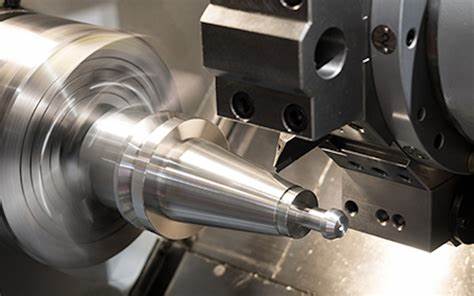
CNC lathes rotate the workpiece while a stationary tool removes material. They excel at producing cylindrical parts—shafts, bushings, threaded components.
Capabilities:
- Turning, facing, threading
- Live tooling for milling operations
- Swiss-type lathes for small, intricate parts
CNC Grinders
Grinding machines use abrasive wheels to achieve ultra-precise surface finishes and tolerances. They are typically used for finishing operations after heat treatment.
Applications:
- Cylindrical grinding for bearing surfaces
- Surface grinding for flat components
- Centerless grinding for high-volume shaft production
Wire EDM (Electrical Discharge Machining)
Wire EDM uses electrical discharges to cut conductive materials. It produces sharp internal corners and intricate profiles that milling cannot achieve.
Key advantage: No cutting forces—ideal for delicate or hardened materials.
Why Is CNC Precision Machining Important?
Aerospace and Defense
Aerospace components operate in extreme conditions. A turbine blade faces temperatures up to 1,700°C, rotational speeds beyond 15,000 RPM, and centrifugal forces exceeding 10,000 G. A deviation of ±0.001 inches (0.025 mm) can cause imbalance, vibration, and catastrophic failure.
Impact:
Over 80% of critical aerospace components are now produced using CNC precision machining. This has significantly improved aircraft safety, reliability, and fuel efficiency.
Structural components:
Aircraft fuselage parts must fit together perfectly to ensure airtightness and structural integrity. CNC machining produces parts with exact dimensions, reducing post-production fitting and adjustment.
Medical and Dental
Medical implants demand precision that directly affects patient outcomes. A hip implant must match the patient’s bone structure precisely to ensure proper function and long-term stability.
Custom implants:
CNC machining enables custom-designed implants using biocompatible materials—titanium, PEEK, cobalt-chrome. Each implant can be tailored to the patient’s anatomy, improving fit and reducing rejection risk.
Surgical instruments:
Minimally invasive surgical tools require extreme precision. The tips of robotic-assisted surgical arms may need tolerances of ±0.01 mm. CNC machining delivers this accuracy.
Data:
A study by the Medical Device Manufacturers Association found that CNC precision machining has led to a 30% reduction in surgical complications related to implant failure or instrument malfunction.
Automotive and Transportation
Engine components—cylinder heads, engine blocks, crankshafts—require precise dimensions for proper function. A cylinder bore tolerance of ±0.05 mm ensures proper piston movement, compression, and efficiency.
Fuel efficiency impact:
A study by the Society of Automotive Engineers found that vehicles with CNC-machined engine and transmission components achieved 15% better fuel efficiency compared to those with traditionally manufactured components.
Transmission parts:
CNC-machined gears have consistent tooth profiles, reducing noise, wear, and power loss. Smooth power transfer translates to better acceleration and durability.
Electronics and Semiconductor
The electronics industry demands precision at the microscopic level. Modern computer processors contain features as small as 7 nanometers—far beyond the scale of mechanical machining. CNC precision machining supports semiconductor production through:
- Wafer handling equipment: Precision fixturing and positioning systems
- Circuit board drilling: Hole diameters with ±0.01 mm tolerance
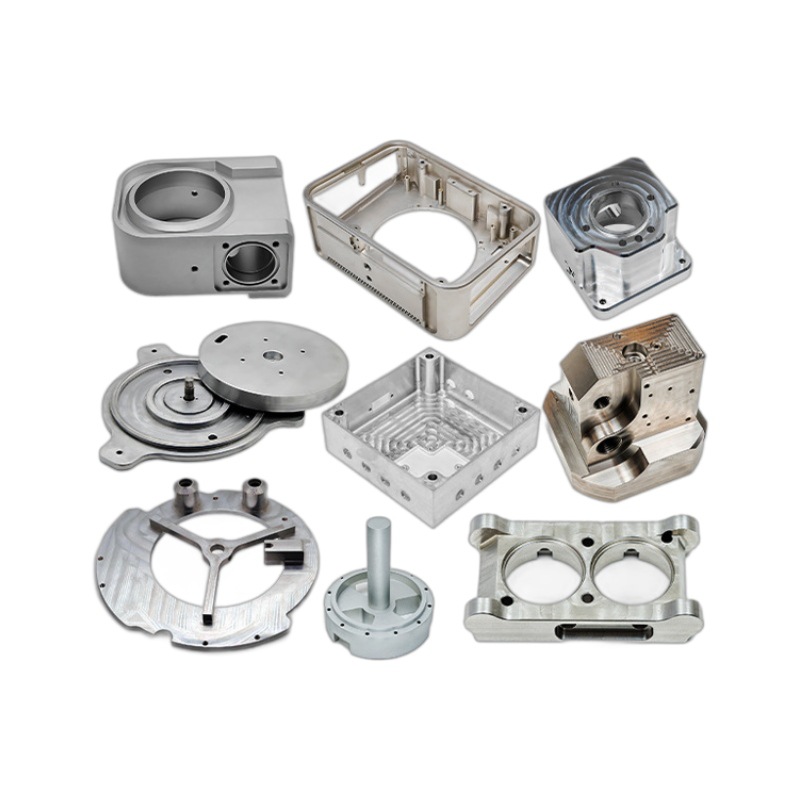
- Enclosures and heat sinks: Complex geometries for thermal management
Impact:
The Semiconductor Industry Association credits CNC precision machining as instrumental in the continuous miniaturization and performance improvement of electronic devices—enabling smaller, more powerful smartphones, laptops, and other gadgets.
What Is the CNC Precision Machining Process?
Design and Programming
The process begins with CAD software—creating a detailed 3D model of the part. Engineers define every feature: dimensions, tolerances, surface finish requirements.
CAM software then generates toolpaths. It calculates:
- Where the tool should move
- How fast it should travel
- What spindle speed to use
- Which tools to use and when
The output is G-code—a standardized programming language that CNC machines understand.
Setup and Machining
Workholding:
The workpiece must be secured without distortion. Options include:
- Vises and chucks for standard parts
- Vacuum fixtures for thin materials
- Custom soft jaws for delicate components
Tool selection:
Tools are chosen based on material and operation:
- Carbide for general machining
- Diamond-coated for high-finish requirements
- Ceramic for high-speed machining of hardened materials
Machining:
The CNC machine executes the program. For complex parts, multiple tools may be used in sequence. In 5-axis machining, the workpiece may be rotated to access multiple surfaces without repositioning.
Inspection and Quality Control
Precision machining without verification is guesswork. Quality control includes:
- In-process inspection: Measuring critical dimensions during production
- CMM (Coordinate Measuring Machine): Verifying complex geometries
- Surface profilometers: Measuring roughness
- Statistical process control (SPC): Tracking variations across production runs
A Real-World Example
A medical device manufacturer needed titanium spinal implants with:
- ±0.005 mm tolerances on mating surfaces
- Complex curved geometry for bone integration
- Surface finish Ra 0.8 μm for biocompatibility
The CNC precision machining process:
- CAD design: Custom model based on patient anatomy
- CAM programming: 5-axis toolpaths optimized for titanium
- Setup: Custom fixturing to hold delicate implant
- Machining: 5-axis CNC mill completed all features in one setup
- Inspection: CMM verification of every critical dimension
Result:
- Implants fit perfectly in surgery
- Zero post-operative complications related to fit
- Patient recovery time reduced by 20%
Conclusion
CNC precision machining transforms digital designs into physical reality with accuracy measured in micrometers. It enables industries to achieve tolerances—±0.001 mm in semiconductor applications, ±0.005 mm in medical implants, ±0.01 mm in aerospace components—that were impossible with traditional methods. Beyond precision, it delivers consistency across production runs, efficiency through automation, and the ability to create complex geometries that define modern products. From jet engines to hip implants, from smartphones to electric vehicles, CNC precision machining is the enabling technology that makes innovation possible. As tolerances continue to tighten and geometries become more complex, its importance will only grow.
FAQs
What is the difference between CNC machining and CNC precision machining?
CNC machining is the broader term for computer-controlled material removal. CNC precision machining refers specifically to operations that achieve very tight tolerances—typically ±0.01 mm or better—using high-precision equipment, optimized tooling, and rigorous quality control. Precision machining is distinguished by its repeatability and ability to hold tolerances that matter in critical applications.
What tolerances can CNC precision machining achieve?
Standard CNC machining achieves ±0.01 mm. High-precision CNC equipment, combined with skilled programming and process control, achieves ±0.001 mm (1 micron) or better. The achievable tolerance depends on part geometry, material, machine capability, and process stability. Semiconductor applications often require tolerances at the micron level.
What industries benefit most from CNC precision machining?
Aerospace, medical device, automotive, and electronics industries benefit most. These sectors require components with tight tolerances, complex geometries, and consistent quality. In aerospace, precision machining ensures turbine blades and structural parts meet safety requirements. In medical, it enables custom implants and precise surgical instruments. In automotive, it improves engine efficiency and reliability. In electronics, it supports miniaturization and performance.
Can CNC precision machining handle all materials?
CNC precision machining handles a wide range of materials: metals (aluminum, steel, stainless, titanium, Inconel), plastics (PEEK, acrylic, polycarbonate, UHMWPE), composites (carbon fiber), and even wood. The key is matching tools, speeds, and feeds to the material. Harder materials require carbide or ceramic tools; softer materials need sharp edges to prevent deformation.
How does CNC precision machining ensure consistent quality?
Consistency comes from program-driven automation. Once a program is verified, the CNC machine produces identical parts within specified tolerances—hour after hour, day after day. Quality control includes in-process inspection, CMM verification, and statistical process control to detect and correct variations before they produce non-conforming parts.
Contact Yigu Technology for Custom Manufacturing
At Yigu Technology, CNC precision machining is our core competency. We operate a range of high-precision CNC mills, lathes, and multi-axis machining centers capable of achieving tolerances down to ±0.005 mm. Our engineering team develops optimized toolpaths and selects the right tools for your material and geometry. Quality control includes CMM inspection and surface finish verification to ensure every part meets your specifications. Whether you need aerospace components, medical implants, automotive parts, or electronics enclosures, we deliver precision that matters. Contact us to discuss your precision machining project.