Introduction
Bakelite—the world’s first fully synthetic plastic—has been a manufacturing staple for over a century. Invented by Leo Baekeland in 1907, this thermosetting resin earned the nickname “the material of a thousand uses” for its versatility, heat resistance, and electrical insulation properties. From electrical insulators and automotive components to kitchenware and jewelry, Bakelite products have stood the test of time.
But in today’s world of advanced engineering plastics and modern manufacturing processes, the question arises: does Bakelite molding still have a place? The answer depends on your application. Bakelite excels where heat resistance, dimensional stability, and electrical insulation are critical—and where cost-effectiveness matters.
This guide provides a comprehensive overview of Bakelite molding. You will learn about the material’s properties, molding processes, applications, advantages, and limitations. By comparing Bakelite with alternatives like polycarbonate and aluminum, you can determine whether it is the right choice for your manufacturing needs.
What Is Bakelite and What Makes It Unique?
Bakelite is a thermosetting plastic formed by the polymerization of phenol and formaldehyde. Unlike thermoplastics, which can be remelted and reshaped, Bakelite undergoes an irreversible chemical reaction during molding. Once cured, it cannot be remelted—a property that gives it exceptional heat resistance and dimensional stability.
Chemical Structure and Properties
The cross-linked polymer structure of Bakelite creates a rigid, durable material with:
| Property | Typical Value | Significance |
|---|---|---|
| Density | 1.3–1.4 g/cm³ | Contributes to strength and durability |
| Hardness | Shore D 85–90 | Resistant to scratches and abrasion |
| Tensile strength | 30–50 MPa | Sufficient for many mechanical applications |
| Compressive strength | 100–200 MPa | Withstands significant compressive forces |
| Heat resistance | Up to 150–200°C | Maintains properties at high temperatures |
| Electrical insulation | 10¹²–10¹⁴ Ω·cm | Excellent insulator |
| Dielectric strength | 10–30 kV/mm | Withstands high voltages |
Key Characteristics
| Characteristic | Description |
|---|---|
| Thermosetting | Cures irreversibly; cannot be remelted |
| Heat resistant | Operates at 150–200°C without degradation |
| Electrical insulator | Excellent dielectric properties |
| Dimensional stability | Low shrinkage; maintains shape under load |
| Chemical resistance | Resists oils, solvents, and dilute acids |
| Hard and rigid | High surface hardness; scratch-resistant |
| Brittle | Low impact resistance; can crack under shock |
What Are the Bakelite Molding Processes?
Bakelite can be molded using several techniques, each suited to different production volumes and part geometries.
Compression Molding
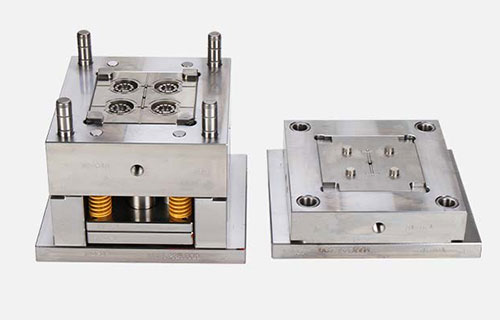
Compression molding is the most common method for Bakelite, especially for larger or thicker parts.
Process Description:
- A pre-measured amount of Bakelite resin (pellet, sheet, or powder) is placed in a heated mold cavity
- The mold closes, applying heat and pressure
- The material softens, flows, and fills the cavity
- Heat initiates the curing (cross-linking) reaction
- The part solidifies and is ejected
| Advantages | Disadvantages |
|---|---|
| Suitable for large, thick parts | Longer cycle times (minutes) |
| Lower tooling cost | Limited complexity; less detail |
| Good for high-pressure applications | Lower production rates |
| High-density; excellent mechanical properties | More manual labor |
Best for: Large parts, thick-walled components, low-to-medium volume production.
Injection Molding
Injection molding of Bakelite is used for high-volume production of smaller, precision parts.
Process Description:
- Bakelite resin is pre-heated in a barrel
- The material is injected into a closed mold under high pressure
- Heat cures the material in the mold cavity
- The part is ejected after curing
| Advantages | Disadvantages |
|---|---|
| High-volume production capability | Higher initial equipment investment |
| High precision; complex shapes | Material waste (sprue; runners) |
| Short cycle times (seconds to minutes) | More complex tooling |
| Excellent surface finish | Limited to smaller parts |
Best for: Small, complex parts, high-volume production, electronics components.
Transfer Molding
Transfer molding is a hybrid process used for Bakelite when precise control of material placement is required.
Process Description:
- Material is placed in a transfer pot
- A plunger forces the material through runners into the mold cavity
- Heat cures the material
Best for: Parts with delicate inserts; moderate complexity; medium volumes.
What Are the Applications of Bakelite Molding?
Bakelite’s unique combination of properties makes it valuable across industries.
Electrical and Electronic Industry
| Application | Why Bakelite? |
|---|---|
| Electrical insulators | Excellent insulation; withstands high voltage (10–30 kV/mm) |
| Switch housings | Arc resistance; dimensional stability |
| Circuit boards | Heat resistance; electrical insulation (though largely replaced by FR-4) |
| Connectors | Precision molding; insulation properties |
Example: In high-voltage switchgear, Bakelite insulators prevent electrical arcing and ensure safe operation.
Automotive Industry
| Application | Why Bakelite? |
|---|---|
| Brake pads and clutch facings | Heat resistance; frictional properties |
| Distributor caps | Electrical insulation; heat resistance |
| Knobs and handles | Durability; heat resistance; moldability |
| Decorative trim | Aesthetic appeal; durability |
Example: Brake components generate significant heat. Bakelite maintains structural integrity and reliable braking performance under high temperatures.
Consumer Goods
| Application | Why Bakelite? |
|---|---|
| Pot handles | Heat resistance; stays cool to the touch |
| Kitchen utensils | Durability; heat resistance |
| Jewelry | Intricate shapes; attractive appearance; vintage appeal |
| Decorative items | Moldability; surface finish |
Example: Bakelite pot handles remain cool even when the pot is heated on the stove, providing safety and comfort.
Industrial Applications
| Application | Why Bakelite? |
|---|---|
| Gears and pulleys | Dimensional stability; wear resistance |
| Pump components | Chemical resistance; strength |
| Tool handles | Durability; heat resistance |
What Are the Advantages of Bakelite Molding?
Cost-Effectiveness
Bakelite raw materials (phenol and formaldehyde) are widely available and inexpensive. Compression molding tooling costs are relatively low, making Bakelite an attractive option for cost-sensitive applications.
Cost comparison: Bakelite is typically less expensive than engineering plastics like polycarbonate, PEEK, or advanced composites.
Good Mechanical and Electrical Properties
Bakelite combines:
- Hardness – Scratch-resistant surface
- Strength – Adequate tensile and compressive strength for many applications
- Electrical insulation – Excellent dielectric properties
- Heat resistance – Operates at 150–200°C
This combination allows a single material to serve multiple functional requirements.
Heat Resistance
Bakelite withstands high temperatures without significant degradation. This reduces the risk of component failure due to overheating and extends product lifespan in heat-intensive applications.
Dimensional Stability
Low shrinkage and stable properties under load make Bakelite ideal for precision components that must maintain shape across temperature variations.
What Are the Limitations of Bakelite Molding?
Brittleness
Bakelite has low impact resistance. It can crack or chip under sudden shock or stress. For applications requiring impact toughness, alternatives like polycarbonate or nylon may be more suitable.
Limited Color Options
Bakelite is naturally dark (brown, black, or dark amber). While it can be pigmented, color options are limited compared to thermoplastics. Vibrant or transparent colors are not achievable.
Non-Recyclable
As a thermoset, Bakelite cannot be remelted or reshaped after curing. Scrap cannot be recycled into new products in the same way thermoplastics can. This raises environmental concerns for applications where recyclability is a priority.
Processing Constraints
- Longer cycle times in compression molding
- Limited part complexity in compression vs. injection molding
- Material waste in injection molding (sprue; runners)
How Does Bakelite Compare to Alternative Materials?
Bakelite vs. Polycarbonate
| Property | Bakelite | Polycarbonate |
|---|---|---|
| Impact resistance | Low (brittle) | High (excellent) |
| Transparency | Opaque; limited colors | Highly transparent; wide color options |
| Heat resistance | 150–200°C | 130–140°C continuous |
| Cost | Relatively low | Higher |
| Recycling | Difficult; non-recyclable | Recyclable (though challenging) |
Choose Bakelite when: Heat resistance, electrical insulation, and cost are priorities; impact resistance is not critical.
Choose Polycarbonate when: Impact resistance, transparency, or wide color options are required.
Bakelite vs. Aluminum
| Property | Bakelite | Aluminum |
|---|---|---|
| Electrical conductivity | Insulator (excellent) | Conductor (good) |
| Thermal conductivity | Low | High (200–240 W/(m·K)) |
| Mechanical strength | Good for its weight | Very high strength-to-weight (alloy-dependent) |
| Ductility | Brittle | Ductile; formable |
| Corrosion resistance | Good chemical resistance | Good with anodizing or coatings |
| Cost | Lower for small-medium scale | Varies; higher for high-performance alloys |
Choose Bakelite when: Electrical insulation, low cost, and moderate mechanical strength are needed.
Choose Aluminum when: Electrical conductivity, high thermal conductivity, or high strength-to-weight ratio is required.
Bakelite vs. ABS
| Property | Bakelite | ABS |
|---|---|---|
| Heat resistance | 150–200°C | 80–100°C |
| Impact resistance | Low | High |
| Electrical insulation | Excellent | Good |
| Cost | Low | Low to moderate |
| Recyclability | Non-recyclable | Recyclable |
Choose Bakelite when: High heat resistance or electrical insulation is critical.
Choose ABS when: Impact resistance and recyclability are priorities.
How Do You Choose Bakelite Molding for Your Project?
Assessment Checklist
| Factor | Questions to Ask |
|---|---|
| Temperature | Will the part be exposed to high temperatures (150–200°C)? |
| Mechanical stress | Will the part experience impact or shock? (Bakelite is brittle) |
| Electrical requirements | Does the part need electrical insulation? |
| Aesthetics | Are color options or transparency required? |
| Volume | What is the production volume? (Compression for low-medium; injection for high) |
| Budget | What is the tooling and per-part cost target? |
| Environmental | Is recyclability a concern? |
Decision Framework
Choose Bakelite molding if:
- High heat resistance is required (150–200°C)
- Electrical insulation is critical
- Cost is a significant factor
- Impact resistance is not a primary concern
- Production volume is low to medium (compression) or high (injection)
- Aesthetic color options are not critical
Consider alternatives if:
- High impact resistance is needed → polycarbonate, ABS, nylon
- Transparency or wide color options are required → polycarbonate, acrylic
- Electrical conductivity or thermal conductivity is needed → aluminum
- Recyclability is a priority → thermoplastics (ABS, polypropylene)
- Extreme precision or very complex geometries are required → injection-molded thermoplastics
Conclusion
Bakelite molding remains a viable manufacturing option for applications requiring heat resistance, electrical insulation, dimensional stability, and cost-effectiveness. Its unique thermosetting properties deliver performance that many modern thermoplastics cannot match at similar cost points.
Key considerations:
- Advantages: Cost-effective, excellent electrical insulation, heat resistance to 200°C, dimensional stability, high surface hardness
- Limitations: Brittle (low impact resistance), limited color options, non-recyclable, longer cycle times in compression molding
- Best applications: Electrical insulators, automotive brake components, heat-resistant handles, precision industrial parts
When selecting Bakelite molding, evaluate your application’s requirements against the material’s properties. For high-heat, high-insulation applications where impact resistance is not critical, Bakelite is often the ideal choice. For applications demanding transparency, impact toughness, or recyclability, alternatives like polycarbonate, ABS, or aluminum may be more suitable.
Frequently Asked Questions (FAQ)
What are the main advantages of Bakelite molding?
Bakelite offers cost-effectiveness, excellent electrical insulation, heat resistance (150–200°C), dimensional stability, and high surface hardness. These properties make it ideal for electrical insulators, automotive brake components, and heat-resistant consumer goods. Tooling costs for compression molding are relatively low, making it economical for low-to-medium volumes.
What are the limitations of Bakelite?
Bakelite is brittle with low impact resistance—it can crack or chip under shock. Color options are limited (typically dark brown, black, or amber). As a thermoset, it is non-recyclable—scrap cannot be remelted. Compression molding has longer cycle times (minutes) and limited geometric complexity compared to injection molding of thermoplastics.
How does Bakelite compare to polycarbonate?
Bakelite has higher heat resistance (150–200°C vs. 130–140°C) and better electrical insulation, but much lower impact resistance (brittle vs. tough). Bakelite is opaque and less expensive; polycarbonate is transparent and offers wide color options. Bakelite is non-recyclable; polycarbonate can be recycled. Choose Bakelite for heat/insulation; choose polycarbonate for impact resistance and transparency.
What molding processes are used for Bakelite?
Compression molding is common for large, thick parts—lower tooling cost, longer cycles. Injection molding is used for high-volume, small, precision parts—higher equipment cost, shorter cycles. Transfer molding is used for parts requiring precise material placement or delicate inserts. The choice depends on part size, complexity, volume, and cost targets.
Is Bakelite still used in modern manufacturing?
Yes. Bakelite remains in use for electrical insulators, automotive brake components, heat-resistant handles, and industrial parts where its unique properties—heat resistance, electrical insulation, dimensional stability—are required. While replaced in some applications by modern thermoplastics, Bakelite’s cost-effectiveness and performance make it the preferred choice for many high-heat, high-insulation applications.
Contact Yigu Technology for Custom Manufacturing
At Yigu Technology, we specialize in Bakelite molding for applications requiring heat resistance, electrical insulation, and dimensional stability. Our expertise spans compression molding, injection molding, and transfer molding—delivering high-quality custom components for automotive, electrical, and industrial sectors.
Our Bakelite molding capabilities include:
- Compression molding – Large parts; thick walls; low-to-medium volume
- Injection molding – High-volume; precision; complex shapes
- Material expertise – Standard Bakelite grades; specialized formulations
- Precision tooling – Durable molds for long production runs
- Quality assurance – Dimensional inspection; electrical testing; heat resistance validation
We help clients select the right process and material for their application—balancing performance, cost, and production requirements.
Contact us today to discuss your Bakelite molding project. Let our expertise help you make the right choice for your manufacturing needs.