Introduction
You need a part that fits perfectly. Not almost perfect. Not within a few thousandths of an inch. Perfect. Maybe it is a titanium bone screw that must thread smoothly into an implant. Or a turbine blade that will spin at 50,000 RPM inside an aircraft engine. When failure is not an option, you cannot trust just anyone with the work.
Precision machining shops exist to solve exactly these problems. But not all shops deliver the same level of quality. Some talk about precision but deliver parts that require hand fitting. Others have the equipment but lack the processes to ensure consistency.
At Yigu Technology, we have worked with shops across the spectrum. We have seen what separates the exceptional from the average. This guide walks you through what precision really means, what capabilities to look for, and how to choose a shop that delivers on its promises.
What Does “Precision” Really Mean?
Beyond the Buzzword
When a shop says they do precision machining, ask for numbers. Precision is measurable. It is not a marketing term. It means holding dimensions within specified tolerances, consistently, part after part.
The best shops operate at the sub-micron level. That is tolerances of 0.001 mm or smaller. To put that in perspective, a human hair is about 50 microns thick. Sub-micron precision is fifty times finer than a hair.
Levels of Precision
| Precision Level | Tolerance Range | Typical Applications |
|---|---|---|
| Standard Machining | ±0.05–0.10 mm | General industrial parts, brackets, housings |
| High Precision | ±0.01–0.05 mm | Automotive components, mechanical assemblies |
| Ultra-Precision | ±0.001–0.01 mm | Medical implants, aerospace components |
| Sub-Micron | <0.001 mm | Optical components, semiconductor tooling |
Real-World Example
An aerospace client came to us with a turbine blade project. The blade had a curved profile with features requiring ±0.002 mm tolerances. A standard shop had already failed twice. Parts were rejected after inspection.
We used ultra-precision machining with a 5-axis setup. The result: all dimensions held within spec. More importantly, the blades performed 15% more efficiently in engine tests because the tighter tolerances improved aerodynamic flow.
What Capabilities Should You Look For?
Ultra-Precision Machining
Some parts require accuracy that exceeds standard equipment. Ultra-precision machining uses specialized machines, controlled environments, and advanced tooling to achieve tolerances below 0.005 mm.
Applications:
- Optical lens mounts where light alignment is critical
- Fuel injector nozzles with micron-sized holes
- Medical guidewires with consistent diameters
Key requirement: Temperature-controlled environments. Metal expands when warm. A shop without climate control cannot hold tight tolerances consistently.
High-Accuracy Milling and Turning
Most precision work falls into milling and turning. The difference between a standard shop and a precision shop is not the machine type—it is how well they use it.
| Operation | Standard Capability | Precision Capability |
|---|---|---|
| Milling | ±0.05 mm | ±0.005 mm |
| Turning | ±0.03 mm | ±0.003 mm |
| Surface finish | Ra 1.6 μm | Ra 0.4 μm |
Real-World Example:
A medical device company needed titanium bone screws with precise thread profiles. Poorly machined threads could damage bone during implantation. Using high-accuracy turning with Swiss-type lathes, we held thread dimensions to ±0.005 mm. The client reported a 20% reduction in patient recovery time because screws seated more cleanly with less tissue damage.
Complex Geometries
Modern designs often include features that were impossible to machine a decade ago. 5-axis machining allows shops to approach a part from multiple angles in a single setup.
Benefits:
- Eliminates multiple setups and their cumulative errors
- Enables undercuts and complex curved surfaces
- Allows thin walls (0.5–2 mm) that would flex under standard machining
Multi-Axis Capabilities
| Axis Count | Best For | Precision Benefit |
|---|---|---|
| 3-axis | Simple geometries, flat parts | Lowest cost, sufficient for many parts |
| 4-axis | Parts requiring indexing around one axis | Reduces setups for cylindrical features |
| 5-axis | Complex contours, turbine blades, medical implants | Single setup; error reduced by up to 80% |
What Equipment Do Top Shops Use?
Essential Machine Tools
You cannot achieve precision without the right equipment. Top shops invest in machines that minimize error and provide control.
| Equipment | Purpose | Precision Benefit |
|---|---|---|
| 5-Axis CNC Machining Centers | Complex parts like aircraft structural components | Reduces setups from 6+ to 1; cuts positioning error by 80% |
| Swiss-Type Lathes | Small, intricate parts like medical pins | Holds tolerances at ±0.005 mm on long, slender parts |
| Jig Grinders | Precision holes and contours | Achieves hole tolerances down to ±0.001 mm |
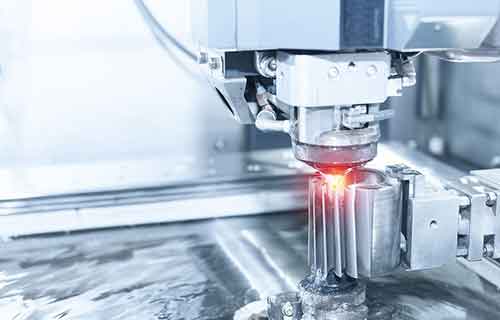
| EDM (Electrical Discharge) | Hard materials, complex cavities | No cutting forces; prevents distortion |
Inspection Equipment
Precision machining requires precision measurement. Shops should have in-house metrology capabilities.
| Equipment | Function | Accuracy |
|---|---|---|
| CMM (Coordinate Measuring Machine) | Measures complex 3D geometries | ±0.001 mm |
| Vision Measuring System | Inspects small features, micro-channels | ±0.0005 mm |
| Surface Profilometer | Measures surface finish (Ra, Rz) | 0.01 μm resolution |
| Laser Scanner | Captures full 3D surface data | ±0.005 mm |
Environmental Controls
Temperature changes cause materials to expand and contract. A shop without climate control cannot hold tight tolerances.
Standard requirement: Temperature maintained at 20°C ± 1°C. Humidity control is also important for certain materials.
Real-World Example:
A semiconductor shop we worked with discovered that parts machined in the morning and afternoon had dimension variations of 0.003 mm. The cause was a 3°C temperature swing in the shop. Installing air conditioning solved the problem. The variation disappeared.
How Do Shops Guarantee Quality?
First Article Inspection (FAI)
Before running a production batch, reputable shops perform First Article Inspection. They machine one part and measure every critical dimension against your drawing.
What FAI includes:
- Full dimensional report with CMM data
- Material certification verification
- Surface finish measurements
- Documentation for your records
Real-World Example:
A medical shop we audited found a 0.01 mm error during FAI on a surgical instrument. The error was traced to a worn tool. Fixing it before production saved 500 defective parts from being made.
Statistical Process Control (SPC)
Monitoring production in real time prevents drift. SPC tracks dimensions as parts are made and alerts operators when trends move toward tolerance limits.
Benefits:
- Catches tool wear before parts go out of spec
- Reduces defect rates by 30–40%
- Provides data for continuous improvement
In-Process Inspection
Some shops inspect parts while they are still in the machine. Probes mounted on the spindle measure critical features and automatically adjust offsets if needed.
Application: A defense shop uses in-process inspection on missile components. Every part is checked for GD&T compliance before being unloaded. The result: zero rejects in the last 50,000 parts.
Certifications That Matter
Certifications mean a shop's processes are audited regularly. They are not optional for critical industries.
| Certification | Industry | What It Covers |
|---|---|---|
| ISO 9001 | General manufacturing | Basic quality management system |
| AS9100 | Aerospace | All ISO 9001 requirements plus aerospace-specific controls |
| ISO 13485 | Medical devices | Regulatory requirements for medical manufacturing |
| IATF 16949 | Automotive | Automotive quality standards |
Which Industries Rely on Precision Shops?
Aerospace
Aerospace components must survive extreme conditions. Titanium and Inconel are common. Tolerances often require ±0.005 mm or tighter.
Typical parts:
- Turbine blades with complex airfoil shapes
- Structural brackets for airframes
- Landing gear components
- Engine mounts
Why precision matters: A turbine blade that is out of spec by 0.01 mm can unbalance a rotating assembly, leading to premature failure.
Medical and Surgical
Medical devices go inside the human body or are used in critical procedures. Surface finish is as important as dimensions. Rough surfaces can harbor bacteria or cause tissue irritation.
Typical parts:
- Orthopedic implants (hip, knee, spine)
- Surgical instruments
- Dental implants
- Diagnostic equipment components
Surface requirements: Many medical components require Ra 0.02 μm or smoother. That is a surface so fine it reflects light like a mirror.
Semiconductor
Semiconductor manufacturing equipment operates at scales measured in nanometers. A single flaw can ruin a $1 million machine.
Typical parts:
- Wafer chucks that hold silicon wafers
- Process chamber liners
- Handling tools and grippers
- Vacuum components
Material considerations: Many semiconductor parts require ceramics or PEEK because these materials do not outgas or contaminate the cleanroom environment.
Automotive
Modern vehicles contain hundreds of precision-machined components. The shift to electric vehicles has added new requirements.
Typical parts:
- Battery enclosure components
- Motor housings
- Transmission parts
- Sensor housings
Volume considerations: Automotive shops must balance precision with high-volume production. A part that takes 10 minutes to machine may need to be made in batches of 50,000.
Prototype Development
Precision shops are also essential for prototyping. When you need to test a design quickly, you cannot wait for tooling.
Real-World Example:
An automotive R&D team needed a custom sensor housing in three days. A precision shop using high-accuracy milling delivered a prototype that matched the 3D model perfectly. The team validated their design in time for a critical investor presentation.
How Do Shops Handle Challenging Materials?
Exotic Alloys
Materials like Inconel, Waspaloy, and titanium are common in aerospace. They are strong, heat-resistant, and difficult to machine.
Challenges:
- Work hardening: The material gets harder as you cut it
- Heat generation: Exotic alloys retain heat, which accelerates tool wear
- Tool life: Carbide tools may last only 15–20 minutes
Solutions:
- Slow, controlled cutting speeds
- Rigid setups to minimize vibration
- High-pressure coolant to evacuate chips and reduce heat
Ceramics
Ceramics offer hardness and heat resistance but are brittle. Standard machining cracks them.
Special process: Superabrasive grinding with diamond wheels. This removes material slowly without introducing stresses that cause cracking.
Applications: Medical implants, semiconductor tooling, wear components.
Hardened Tool Steels
Mold making often requires machining steel that has been hardened to 50–60 HRC.
Approach: Hard turning with CBN (cubic boron nitride) tools. Post-machining heat treatment is sometimes required to achieve final hardness.
What Finishing Processes Add Value?
Specialized Coatings
Machined parts often require coatings to enhance performance.
| Coating | Purpose | Application |
|---|---|---|
| TiN (Titanium Nitride) | Wear resistance | Cutting tools, medical instruments |
| Ceramic coatings | Corrosion resistance | Marine components, defense parts |
| PTFE (Teflon) | Low friction | Bearings, sliding surfaces |
Real-World Example:
A defense shop applied ceramic coatings to saltwater-exposed components. Coated parts lasted five times longer than uncoated versions.
Surface Finish Analysis
Finish matters for function. A gear with rough surfaces wears faster. A bearing with a poor finish generates heat.
Typical requirements:
- Gears: Ra 0.8 μm or smoother
- Bearing surfaces: Ra 0.2 μm or smoother
- Sealing surfaces: Ra 0.4 μm or smoother
Shops use profilometers to measure surface roughness and verify compliance.
How Do You Choose the Right Shop?
Questions to Ask
Before selecting a shop, ask:
- What tolerances can you hold consistently? (Not "can you hold" but "do you hold")
- What inspection equipment do you have in-house?
- What certifications do you maintain?
- Can you provide a CMM report with every shipment?
- What is your typical lead time for FAI?
- What industries do you typically serve?
Red Flags to Watch For
- Vague answers about tolerances
- No in-house inspection equipment
- Certifications expired or missing
- Unwilling to provide material certifications
- Shop floor temperature uncontrolled
Yigu Technology’s Perspective
At Yigu Technology, we believe a top precision machining shop balances technology, experience, and process discipline. Too many shops rely on equipment alone. They buy expensive machines but lack the skilled operators or quality systems to use them effectively.
We have seen clients waste months with shops that meet tolerances on paper but fail on material certification or delivery reliability. Our recommendation: prioritize shops with ISO 13485 or AS9100 certification for critical projects. These shops are audited annually. Their processes are documented. They cannot take shortcuts.
The future of precision machining lies in AI-driven inspection. Real-time data will catch defects the moment they occur, cutting defect rates further while speeding delivery. Shops that adopt these tools early will lead the market.
Conclusion
A reliable precision machining shop is more than a vendor. They are a partner in your success. The right shop delivers parts that fit the first time, meet specifications consistently, and arrive when promised.
Look for shops with:
- Measurable precision (sub-micron capabilities when needed)
- Advanced equipment (5-axis, Swiss-type, in-house inspection)
- Rigorous quality systems (SPC, FAI, relevant certifications)
- Material expertise (exotic alloys, ceramics, medical-grade materials)
- Process transparency (CMM reports, open communication)
When you find that shop, hold onto them. They are worth the investment.
FAQ
What is the difference between tight tolerances and sub-micron tolerances?
Tight tolerances typically refer to ±0.01 mm to ±0.005 mm. Sub-micron tolerances are tighter than 0.001 mm. Sub-micron work requires specialized equipment, environmental controls, and advanced metrology. It is used for optical components, semiconductor tooling, and ultra-precision aerospace parts.
How can I verify a shop's precision claims?
Ask for a CMM report from a sample part. A reputable shop will provide dimensional data showing every measured feature. Also ask for client references, specifically from your industry. Shops with nothing to hide will share this information willingly.
Can a precision shop handle both prototypes and mass production?
Yes. Top shops use flexible equipment like 5-axis machining centers that can switch between small prototype runs and large production batches efficiently. Look for shops with annual capacities of 100,000+ parts if you need both services from one supplier.
Why is an air-conditioned facility important for precision machining?
Temperature changes cause materials to expand and contract. A shop without climate control can see dimension variations of 0.005 mm or more just from morning-to-afternoon temperature swings. For parts requiring ±0.005 mm tolerances, that variation is unacceptable. Controlled environments at 20°C ± 1°C eliminate this variable.
Contact Yigu Technology for Custom Manufacturing
At Yigu Technology, we operate as the kind of precision machining shop described in this guide. We hold ISO 9001 certification and serve clients in aerospace, medical, automotive, and industrial sectors.
Our capabilities include:
- 5-axis CNC milling with temperature-controlled facilities
- Swiss-type turning for small, precise components
- In-house CMM inspection with full documentation
- Material expertise across titanium, stainless steel, aluminum, plastics, and exotic alloys
We believe in transparency. Every part we ship comes with inspection data. Every project is reviewed by experienced engineers. We do not take shortcuts because your application cannot afford them.
Contact us today to discuss your precision machining needs.