Imagine wearing a piece of jewelry that was designed specifically for you—not just sized to fit, but shaped to match your style down to the smallest detail. 3D printed jewelry makes this possible. Designers now create pieces with complex geometries that traditional methods cannot achieve. They produce custom orders in days instead of weeks. And they do it with less waste. This guide walks you through how 3D printing is reshaping jewelry design, from the initial concept to the final polished piece. You will learn the process, the materials, and why this technology matters for both designers and consumers.
What Exactly Is 3D Printed Jewelry?
3D printed jewelry refers to pieces created using additive manufacturing technologies. Instead of carving or casting from a mold, a 3D printer builds the jewelry layer by layer from a digital file. This approach allows for intricate details, complex internal structures, and precise customization that traditional methods struggle to match.
The process starts with a 3D model created in CAD software. That model gets sliced into thin layers. A printer then builds the piece using materials like resin, metal powder, or plastic filament. The final piece may be printed directly in metal or printed in wax or resin for casting.
How Did This Technology Enter Jewelry?
3D printing has existed since the 1980s, but it took decades to reach jewelry makers. Early printers were expensive and limited in material options. By the 2010s, prices dropped and material quality improved. Designers began experimenting.
Today, 3D printing is common in both high-end fine jewelry and affordable fashion accessories. Major brands use it for prototypes. Independent designers use it to offer custom pieces without holding inventory. The technology has moved from experimental to essential.
What Makes It Better Than Traditional Methods?
The advantages go beyond just being new. 3D printing solves real problems that traditional jewelry making faces.
Customization Without Limits
With traditional casting, changing a design means creating a new mold. That takes time and money. With 3D printing, a designer modifies the digital file and prints the new version immediately.
Real example: A bride wanted a wedding band that matched her engagement ring’s unique contour. A traditional jeweler quoted $1,200 and 4 weeks for a custom mold. A 3D printed design cost $450 and delivered in 10 days. The band fit perfectly.
Speed from Concept to Product
Prototyping with traditional methods requires carving wax or metal by hand. Each iteration takes days. With 3D printing, a designer can test five variations in one day. This speed allows faster response to trends and tighter production schedules.
Lower Costs for Small Batches
Traditional manufacturing relies on economies of scale. A mold for a single ring costs nearly the same as a mold for 100 rings. For small collections or one-off pieces, that cost is prohibitive. 3D printing has no tooling costs. A single piece costs only the material and machine time.
Less Material Waste
Traditional casting often removes material or uses molds that generate waste. 3D printing adds material only where needed. According to industry estimates, material waste can be reduced by 70–90% compared to traditional subtractive methods.
Design Freedom
Complex geometries become possible. Hollow structures, interlocking patterns, and organic forms print without extra steps. A designer can create a piece with internal cavities, lattice structures, or textures that would be impossible to carve or cast.
What Is the Design and Production Process?
The journey from idea to finished jewelry follows a clear sequence. Each step affects the final quality.
Step 1: Concept and CAD Modeling
Every piece starts with a digital model. Designers use software like Rhino, Blender, or MatrixGold to create detailed 3D files. They define every curve, surface, and texture. The digital format allows precise control and easy modifications.
Step 2: Material Selection
The choice of material determines durability, appearance, and cost.
| Material Type | Examples | Best For |
|---|---|---|
| Metals | Gold, silver, titanium, stainless steel | Fine jewelry, everyday wear, high durability |
| Resins | Castable wax resin, standard photopolymer | Prototypes, detailed designs, lost-wax casting |
| Plastics | Nylon, PLA, ABS | Fashion jewelry, prototypes, affordable lines |
| Composites | Metal-filled filaments | Unique finishes, experimental designs |
Step 3: Printing Method
Different technologies suit different materials and goals.
- SLA (Stereolithography): Uses laser to cure liquid resin. High detail. Ideal for intricate designs and casting patterns.
- SLS (Selective Laser Sintering): Fuses nylon powder. Good for durable plastic jewelry and complex geometries.
- DMLS (Direct Metal Laser Sintering): Prints directly in metal. Produces solid, high-quality metal pieces without casting.
- FDM (Fused Deposition Modeling): Uses plastic filament. Best for prototypes and low-cost fashion pieces.
Step 4: Post-Processing
Printed jewelry rarely comes off the printer finished. Most pieces require:
- Support removal: Snapping or dissolving temporary structures
- Sanding and polishing: Smoothing layer lines
- Casting: For resin prints, the piece serves as a pattern for traditional lost-wax casting
- Plating: Adding gold or rhodium finish to base metals
- Stone setting: Adding gems after printing
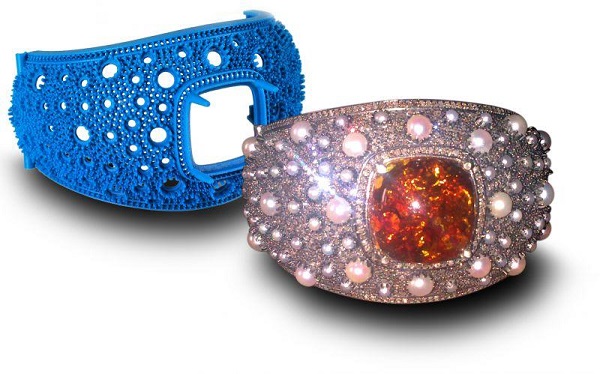
Real example: A designer prints a ring in castable resin. The resin piece gets invested in plaster, burned out in a kiln, and replaced with molten gold. The final ring shows every detail of the original print—including a lattice structure inside the band.
How Is It Being Used in Fashion Today?
3D printed jewelry appears across the fashion spectrum, from luxury houses to independent designers.
Customizable Consumer Pieces
Brands now offer online configurators where customers choose shape, size, and finish. The design prints after the order arrives. This model eliminates inventory risk and gives customers a personalized experience.
Sustainable Collections
Sustainability matters to modern consumers. 3D printing produces less waste and uses less energy than traditional manufacturing in many cases. Some designers use recycled metal powders. Others create pieces that can be melted and reprinted later.
Avant-Garde Art Pieces
Fashion houses use 3D printing to create statement pieces that push boundaries. Runway collections feature jewelry with organic forms, mathematical patterns, and impossible geometries. These pieces would be prohibitively expensive or simply impossible to make by hand.
Bridal and Heirloom Jewelry
Custom wedding rings and anniversary bands are a natural fit. Couples can incorporate fingerprints, handwritten notes, or meaningful patterns into the design. The digital file becomes part of the story—easy to reprint if needed.
What Are the Current Limitations?
Despite the advantages, 3D printed jewelry has limits. Understanding them helps set realistic expectations.
Material Costs
Metal powders for DMLS can cost $300–$800 per kilogram. While material waste is low, the raw material itself is expensive compared to traditional casting grains.
Surface Finish
Printed parts often have a matte or slightly textured finish. Achieving a high polish requires post-processing. For complex designs with deep recesses, polishing can be difficult.
Size Constraints
Most printers have build volume limits. Large statement pieces may need to print in sections and assemble.
Certification and Hallmarking
In many countries, precious metal jewelry must be hallmarked. The process for certifying 3D printed metals varies by region. Some hallmarking offices have adapted, but others still treat printed pieces as unconventional.
What Does the Future Hold?
The technology continues to evolve. Several trends will shape the next decade of 3D printed jewelry.
Direct Metal Printing at Lower Cost
As DMLS machines become more affordable, more jewelers will print directly in precious metals. This eliminates the casting step and shortens production time further.
Multi-Material Printing
Future printers may combine metal and resin in one piece. Imagine a titanium band with soft rubber inlays—printed in one operation.
AI-Generated Designs
Designers already use AI tools to generate patterns and forms. Soon, consumers may input preferences and receive algorithmically generated, one-of-a-kind designs ready to print.
Circular Manufacturing
Recycling printed jewelry becomes easier. A gold ring printed via DMLS can be melted down and reprinted into a new design with minimal material loss. This supports circular economy models.
Conclusion
3D printed jewelry is not a passing trend. It offers designers tools that traditional methods cannot match: speed, customization, design freedom, and reduced waste. For consumers, it means jewelry that fits better, tells a personal story, and arrives faster. For the fashion industry, it represents a shift toward on-demand, sustainable production.
The technology does not replace traditional craftsmanship. Skilled jewelers still set stones, polish surfaces, and apply finishes. But 3D printing handles the complex structures and precise geometries that free up artists to focus on creativity. Together, these methods are expanding what jewelry can be.
FAQ
Is 3D printed jewelry durable?
Durability depends on the material. Metal pieces printed with gold, silver, or titanium are as durable as traditionally made jewelry. Resin and plastic pieces are suitable for occasional wear or fashion jewelry but may not withstand daily impact. Proper care extends the life of all materials.
Can 3D printed jewelry be repaired?
Yes, minor repairs are possible. For resin or plastic pieces, small cracks can often be filled and reprinted. Metal pieces can be soldered or reworked by a jeweler. For valuable pieces, consult a specialist who understands additive manufacturing.
How do I clean 3D printed jewelry?
For metal pieces, use mild soap, warm water, and a soft cloth. Avoid ultrasonic cleaners unless you know the piece can handle them. For resin and plastic, wipe with a damp cloth and dry immediately. Harsh chemicals and abrasives can damage surfaces.
How much does 3D printed jewelry cost?
Costs vary widely. A simple fashion ring in plastic may cost $20–$50. A custom gold ring with complex geometry may range from $500–$2,000. The price reflects material, design complexity, and post-processing work.
Can I design my own 3D printed jewelry?
Yes. Many online services offer design tools where you customize shapes, add text, and choose materials. For more complex designs, you can work with a CAD designer who creates a file ready for printing.
Contact Yigu Technology for Custom Manufacturing
Yigu Technology specializes in non-standard plastic and metal custom manufacturing, including 3D printed jewelry and components. We work with designers, brands, and individuals to turn digital concepts into physical pieces. From castable resin patterns to direct metal printing, our team delivers precision and quality. Contact us today to discuss your custom jewelry or manufacturing project.