Introduction
Imagine a material that bends like skin, seals against moisture, survives extreme temperatures, and feels soft to the touch. That material is silicone. For decades, working with silicone meant molds—expensive, time-consuming, and limited to simple shapes. If you wanted a complex internal channel or a custom-fit medical device, you were out of luck. Silicone 3D printing services have changed everything. Now you can create silicone parts with intricate geometries, tailored properties, and rapid turnaround—without the cost and constraints of traditional molding. This article explores how silicone 3D printing works, the materials available, the design-to-production workflow, and how industries from healthcare to automotive are transforming their creations with this technology.
What Makes Silicone 3D Printing a Game-Changer?
The Silicone Revolution in Additive Manufacturing
Silicone has always been prized for its unique properties:
- Flexibility: Stretches and compresses without permanent deformation
- Biocompatibility: Safe for contact with skin and tissue
- Temperature resistance: Withstands both heat and cold
- Chemical resistance: Resists oils, solvents, and weathering
- Sealing ability: Creates airtight and watertight barriers
But traditional silicone manufacturing required molds—expensive tooling that made sense only for high volumes. Design changes meant new molds. Complex geometries were difficult or impossible. Small batches were cost-prohibitive.
Silicone 3D printing eliminates these barriers. By building parts layer by layer from digital files, it enables:
- Complex geometries: Internal channels, lattice structures, organic shapes
- Customization: Each part can be different without tooling changes
- Rapid iteration: Test designs in days instead of weeks
- Low-volume production: Economical for small batches
What Silicone Materials Are Available for 3D Printing?
Silicone 3D printing uses specially formulated materials, each with unique properties for different applications.
| Material Type | Shore A Hardness | Key Properties | Typical Applications | Compliance Standards |
|---|---|---|---|---|
| Platinum-Cured Silicone | 10–80 | High tear resistance, biocompatible | Medical implants, wearable devices | ISO 10993-10 (biocompatibility) |
| Liquid Silicone Rubber (LSR) | 20–60 | Transparency, low compression set | Seals, gaskets, baby care products | FDA 21 CFR Part 177.2600 (food contact) |
| Fluorosilicone | 40–70 | Chemical resistance, high-temperature stability (up to 200°C) | Aerospace seals, automotive components | ASTM D2000 |
| High-Tear Silicone | 30–80 | Exceptional tear strength | Flexible molds, protective covers | Varies by application |
| Optically Clear Silicone | 40–60 | Transparency, light transmission | Lenses, light guides, medical devices | ISO 10993 |
Platinum-Cured Silicone
Properties: High tear resistance, excellent biocompatibility, available in a range of hardnesses.
Applications: Medical implants, wearable devices, prosthetics. A study in the Journal of Biomedical Materials Research found platinum-cured silicone implants had low rates of immune response in animal models, confirming its suitability for long-term medical use.
Why choose it: When you need material safe for body contact with excellent durability.
Liquid Silicone Rubber (LSR)
Properties: Transparency, low compression set (maintains shape after compression), good mechanical properties.
Applications: Seals, gaskets, baby care products, food-contact items. Its FDA compliance makes it safe for products that may contact food or beverages.
Why choose it: When you need transparent parts or materials that maintain sealing performance over time.
Fluorosilicone
Properties: Excellent chemical resistance, stable at high temperatures (up to 200°C), resists fuels and oils.
Applications: Aerospace seals, automotive components, industrial parts exposed to harsh chemicals. Boeing found fluorosilicone seals in aircraft engines reduced leak risk and improved efficiency.
Why choose it: When your part faces aggressive chemicals or high temperatures.
What Technologies Enable Silicone 3D Printing?
Several advanced processes print silicone, each with different strengths.
| Technology | Deposition Method | Layer Thickness | Precision (XY) | Cure Time | Best For |
|---|---|---|---|---|---|
| Pneumatic Extrusion | Extrudes silicone paste pneumatically | 100–500 μm | ±0.2 mm | 1–2 hours (UV/thermal) | Large prototypes, soft robotics |
| Stereolithography (SLA) | UV-cures liquid silicone resin | 25–100 μm | ±0.05 mm | 10–30 seconds per layer | High-detail parts, microfluidic devices |
| Multi-Jet Printing (MJP) | Droplet-jetting of multi-material silicone | 16–30 μm | ±0.01 mm | Instant (UV-cured) | Multi-hardness components, medical simulators |
| Injection 3D Printing | High-pressure deposition into molds | 50–200 μm | ±0.1 mm | 30 min–1 hour | Low-volume production of industrial seals |
Pneumatic Extrusion
How it works: Silicone paste is forced through a nozzle using air pressure. The printer moves in X, Y, and Z to deposit material layer by layer.
Strengths: Large build volumes, relatively fast, good for big parts.
Limitations: Lower resolution than other methods, visible layer lines.
Best for: Large-scale prototypes, soft robotics components, parts where absolute precision isn't critical.
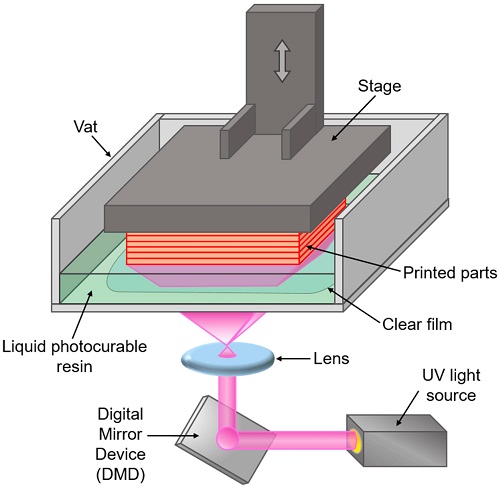
Stereolithography (SLA) for Silicone
How it works: A UV laser cures liquid silicone resin layer by layer. The platform lifts as each layer solidifies.
Strengths: Excellent detail, smooth surfaces, high precision.
Limitations: Smaller build volumes, slower than extrusion for large parts.
Best for: High-detail parts, microfluidic devices, jewelry, medical models requiring fine features.
Multi-Jet Printing (MJP)
How it works: Print heads jet droplets of silicone material, instantly cured by UV light. Multiple materials can be jetted in the same print.
Strengths: Highest resolution, multi-material capability, excellent surface finish.
Limitations: Expensive equipment, limited build size.
Best for: Multi-hardness components, medical simulators, parts requiring different properties in different regions.
Injection 3D Printing
How it works: Hybrid process combining 3D printing with injection molding principles. Silicone is injected into printed molds or directly deposited under pressure.
Strengths: Good production speed for low volumes, combines design freedom with molding efficiency.
Limitations: More complex process, requires specialized equipment.
Best for: Low-volume production of industrial seals, gaskets, and functional parts.
How Does the Design-to-Production Workflow Work?
Digital Design and Customization
CAD Modeling: Engineers use software like AutoCAD, SolidWorks, or Fusion 360 to create precise 3D models. Parametric design capabilities allow exact specification of dimensions, wall thicknesses, and features.
Generative Design: AI-powered platforms like nTopology generate optimized designs based on performance requirements. Input parameters like forces, material properties, and manufacturing constraints produce designs that human designers might never conceive.
Real-world example: Researchers at the University of Michigan used generative design to create a silicone shock-absorbing automotive component. The algorithm reduced material usage by 40% compared to traditional designs while maintaining performance. Cost savings and weight reduction followed.
Pre-Processing: Optimizing for Success
Support Structure Engineering: Automated tools like Materialise Magics generate supports for overhanging features. Modern algorithms create tree-like supports that:
- Use less material than traditional linear supports
- Are easier to remove
- Minimize surface marks
Case study: A complex medical catheter prototype used tree-like supports generated by Magics. Material waste dropped 30% compared to linear supports. Post-processing time decreased 50% because supports removed cleanly without damaging delicate features.
Slicing and Parameter Tuning: Slicing software divides the model into layers and sets critical parameters:
- Layer orientation: Affects mechanical properties. A University of Leeds study found optimizing layer orientation increased tensile strength by 30% .
- Cure intensity: For UV-cured processes, proper exposure ensures complete curing. A medical device manufacturer improved tear resistance of SLA-printed silicone valves by 20% by increasing UV exposure from 80 mJ/cm² to 120 mJ/cm².
- Print speed: Balance between speed and quality. Too fast risks incomplete curing or poor surface finish.
Post-Processing: Refining to Perfection
Curing Optimization: Most silicone prints need post-cure to achieve full properties. For LSR parts, curing at 80°C for 4 hours can increase tensile strength by 15% . Temperature and time must be carefully controlled—too little and curing incomplete, too much and material degrades.
Surface Finishing: Methods to improve surface quality:
- Chemical vapor smoothing: Exposes parts to chemical vapor that melts and smooths surface layers. For endoscopic seals, this reduced surface roughness from Ra 3.2 μm to Ra 0.8 μm—critical for low-friction medical devices.
- Sanding and polishing: For visible or functional surfaces requiring smoothness.
- Coating: Adds protective or functional layers.
How Is Silicone 3D Printing Transforming Industries?
Medical Devices: Customization at the Point of Care
Patient-Specific Implants: A pediatric hospital used extrusion-based silicone printing to create custom tracheal splints for children with airway collapse. Each splint matched the patient's unique anatomy. Results:
- Surgical planning time reduced 60%
- Fit accuracy improved to ±0.1 mm
- Hospital stay shortened by 3 days on average compared to traditional splints
A study in the Journal of Pediatric Surgery confirmed these outcomes—better fit, faster recovery, less trauma.
Wound Care and Rehabilitation: Soft silicone prosthetics mimic natural tissue elasticity. Adjustable Shore A hardness (20–50) allows customization for each patient. A leading prosthetics company reduced prototype costs by 40% using in-house SLA printing. Multiple iterations cost fraction of traditional molding.
Surgical Simulators: Multi-jet printing creates anatomical models with realistic tissue feel. Surgeons practice procedures before operating on real patients. Confidence increases. Complications decrease.
Automotive and Industrial: Durability Meets Design Freedom
Seals and Gaskets: High-temperature fluorosilicone prints withstand 200°C, ideal for engine compartments. Traditional molded seals limited to simple shapes. 3D printing enables complex geometries like multi-lobed seals.
Real-world example: A leading automotive manufacturer replaced traditional engine seals with 3D-printed multi-lobed fluorosilicone seals. Leakage reduced 30% . Better fit and complex geometry improved sealing performance. Engine efficiency improved. Fuel consumption dropped.
Soft Robotics: Silicone actuators printed via multi-jet technology offer precise control:
- Bending angles controlled to ±2°
- Force output from 0.5–5N
- Ideal for adaptive grippers handling delicate objects
A research team developed a soft robotic arm using 3D-printed silicone actuators. Success rate for grasping and manipulating small objects exceeded 90% . The arm adapted to different shapes and sizes—impossible with rigid grippers.
Consumer Electronics and Wearables
Protective Cases: Silicone's shock-absorbing properties protect devices. 3D printing enables complex internal structures that optimize impact resistance while maintaining thin profiles.
Wearable Devices: Custom-fit wristbands, health monitors, and smartwatch bands printed to individual measurements. Platinum-cured silicone ensures skin compatibility.
Custom Seals: Waterproofing for electronics often requires custom seals. 3D printing delivers perfect fit for each device design.
Aerospace Applications
High-Temperature Seals: Fluorosilicone components withstand extreme conditions in aircraft engines and spacecraft. Complex geometries impossible with molding now achievable.
Vibration Dampers: Custom-shaped silicone parts isolate sensitive equipment from vibration. Designs optimized for specific frequency ranges.
Rapid Replacement Parts: When seals fail, new ones print on demand. No inventory. No waiting.
What Are the Key Benefits of Silicone 3D Printing?
Design Freedom
Complex internal channels, lattice structures, variable wall thickness—all possible. Designs optimized for function, not manufacturability.
Customization
Each part can be different without cost penalty. Patient-specific implants. Custom-fit wearables. Unique seals for unique applications.
Speed
Prototypes in days. Iterations overnight. Production parts in weeks instead of months. Time-to-market accelerates.
Cost-Effectiveness for Low Volumes
No tooling costs make small batches economical. A run of 50 parts costs the same per part as a run of 500? No—but the per-part cost for 50 is far lower than traditional molding would be.
Material Properties
Silicone's unique combination of flexibility, biocompatibility, and environmental resistance opens applications no other material can address.
Reduced Waste
Additive process uses material only where needed. Unused material in some processes recycles. Waste typically under 10%.
What Challenges Remain?
Equipment Cost
Industrial silicone 3D printers cost hundreds of thousands to millions. This limits adoption to specialized service bureaus and larger companies.
Material Limitations
While silicone materials expand, not every formulation is printable. Some specialty silicones lack printable versions.
Post-Processing Requirements
Cleaning, support removal, curing, and finishing add time and cost. For complex parts, post-processing can dominate total lead time.
Speed Constraints
Printing is slow compared to injection molding. For high volumes, traditional methods remain faster once tooling exists.
Quality Assurance
Ensuring consistent properties requires process control. For regulated industries like medical, certification demands rigorous testing.
How Does Yigu Technology Approach Silicone 3D Printing?
As a non-standard plastic and metal products custom supplier, Yigu Technology offers silicone 3D printing as part of our advanced manufacturing capabilities. We help clients across industries transform their creations.
Our Experience in Action
Medical device company: Needed custom tracheal splints for pediatric patients. Each child's anatomy unique. We printed patient-specific splints from CT data using platinum-cured silicone. Surgeons reported perfect fit, reduced surgery time, faster recovery.
Automotive manufacturer: Required high-temperature seals for a new engine design. Complex geometry impossible to mold. We printed fluorosilicone seals with multi-lobed profiles. Leak testing showed 30% improvement over previous designs.
Wearable tech startup: Needed custom-fit wristbands for a health monitoring device. Traditional molding required minimum quantities far beyond their needs. We printed 50 prototypes in various sizes and hardnesses. Testing validated design. Production followed.
Our Capabilities
We maintain multiple silicone printing technologies:
- Pneumatic extrusion for larger parts
- SLA for high-detail components
- Multi-jet printing for multi-material and highest resolution
- Injection 3D printing for low-volume production
Material Expertise
We work with all major silicone formulations:
- Platinum-cured for medical applications
- LSR for transparency and food contact
- Fluorosilicone for high-temperature and chemical resistance
- Custom formulations for specific requirements
Quality Commitment
For medical and aerospace applications, we maintain:
- Process validation
- Material traceability
- Inspection protocols
- Documentation for certification
Conclusion
Silicone 3D printing services are transforming what's possible with this remarkable material. By eliminating the constraints of traditional molding, they enable:
- Complex geometries impossible before
- Customization for individual patients and applications
- Rapid iteration that accelerates development
- Cost-effective low volumes that make sense for prototypes and small batches
From life-saving medical implants to high-performance industrial seals, silicone 3D printing delivers solutions that were previously out of reach. The technology continues to advance—faster printers, better materials, higher resolution. As it does, the range of applications will only expand.
For designers, engineers, and innovators, the message is clear: if you can imagine it in silicone, you can probably print it. The only limit is your creativity.
Frequently Asked Questions
Q1: What is the typical turnaround time for silicone 3D printing projects?
Turnaround varies by complexity and technology. Simple prototypes: 3–5 business days. Larger, complex projects: 1–2 weeks. Your service provider can give an estimate based on your specific file and requirements.
Q2: Can silicone 3D printing be used for mass production?
Yes, for low-to-medium volumes. Processes like injection 3D printing achieve production speeds suitable for small-scale mass production. For extremely high volumes (millions of parts), traditional injection molding remains more economical once tooling exists.
Q3: How do I ensure the quality of 3D-printed silicone parts?
Quality assurance involves:
- Proper design optimization (support structures, parameter tuning)
- Process monitoring during printing
- Post-processing (curing optimization, surface finishing)
- Inspection (dimensional verification, mechanical testing)
Work with experienced providers who have quality systems in place.
Q4: What hardness ranges are available in 3D-printed silicone?
Shore A hardness from 10 (very soft) to 80 (firm) is commonly available. Different materials offer different ranges. Your provider can help select the right hardness for your application.
Q5: Is 3D-printed silicone biocompatible?
Yes, with the right material. Platinum-cured silicones meet ISO 10993 standards for biocompatibility and are used in medical implants, surgical guides, and wearable devices. Always verify material certifications for medical applications.
Q6: Can I print multi-material silicone parts?
Yes, using multi-jet printing technology. You can combine different hardnesses in the same part—soft grip areas with firm structural bases, for example. This enables designs with graded properties.
Q7: How durable are 3D-printed silicone parts compared to molded ones?
Properly printed and post-processed silicone parts achieve properties comparable to molded equivalents. Tear strength, elongation, and compression set can match or approach traditionally manufactured silicone. Process optimization is key.
Contact Yigu Technology for Custom Manufacturing
Ready to explore silicone 3D printing for your next creation? At Yigu Technology, we combine material science expertise with advanced printing capabilities. Our team helps you select the right silicone formulation, optimize designs for printability, and deliver quality parts on schedule.
Visit our website to see our capabilities. Contact us today for a free consultation and quote. Let's transform your ideas into reality with silicone.